
You’re halfway through a tight product development deadline. The prototype vibrates too much, or a mechanism fails to reset properly. Colleagues turn to you for a fix, and the pressure hits when you realize the solution likely involves the right spring in engineering. This exact scenario trips up many entry-level designers and maintenance engineers every day.
Read this guide and you will know exactly what a spring in engineering is, the main types that exist, how they work in real applications, and the simple steps to choose the correct one for your next project. You will finish with actionable knowledge you can use on the job tomorrow.
Springs store mechanical energy when deformed and release it to return to their original shape. This basic ability makes them essential in almost every machine you touch.
Let’s start with the fundamentals so you can apply them immediately.
What a Spring in Engineering Actually Does
Simple Definition Every Engineer Should Know
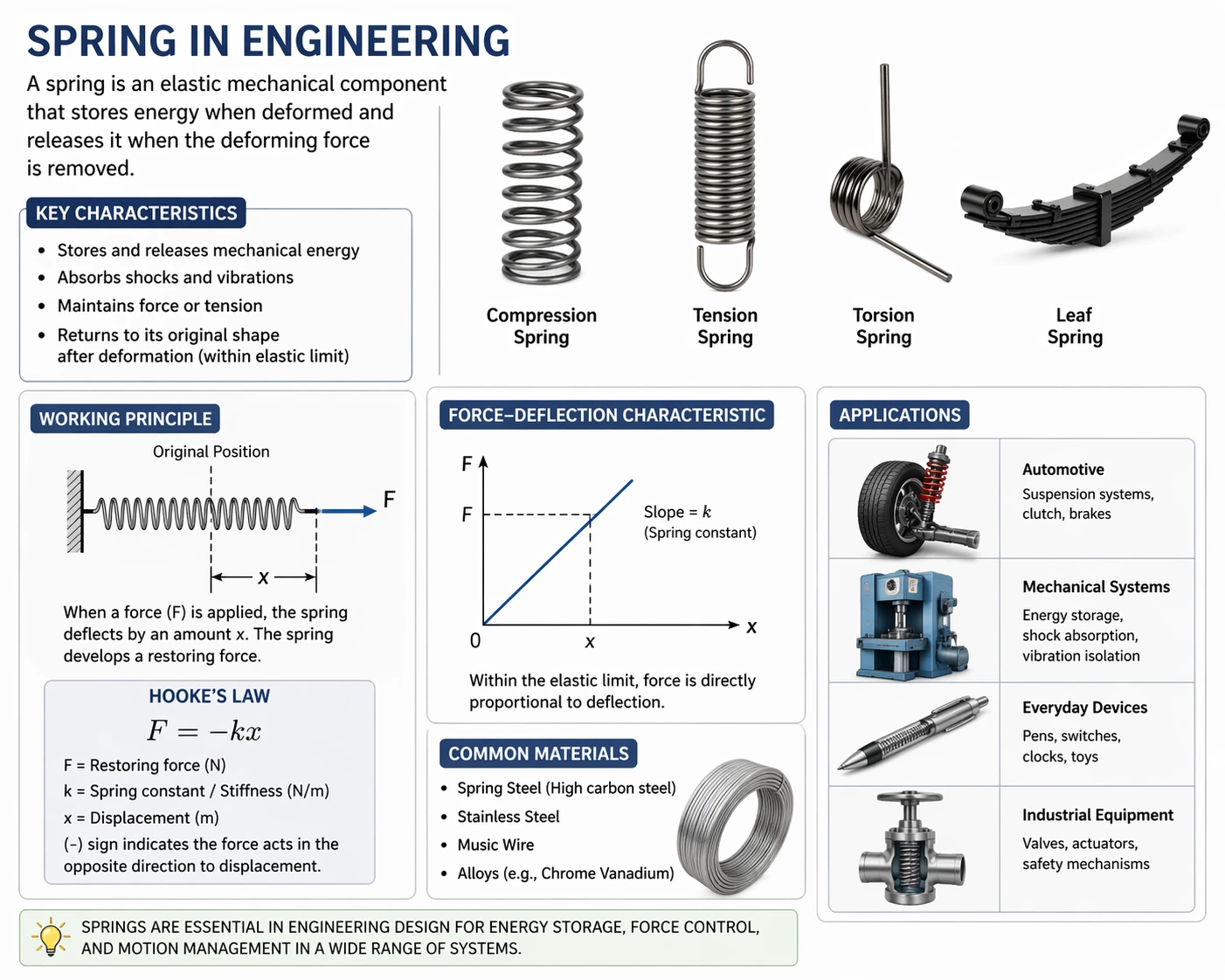
A spring in engineering is an elastic component designed to deform under load and snap back when the load is removed. It stores potential energy during deformation and releases it as kinetic energy or restoring force.
Think of it like a stretched rubber band in a slingshot. You pull, it stores energy, then launches the projectile when released. Springs work the same way but with metal for precision and durability.
Why this matters to you: On the factory floor or in a design review, you can now explain in 10 seconds why a specific spring solves a motion or vibration issue instead of guessing.
The Core Principle Behind Every Spring
Hooke’s Law governs most springs within their working range. It states that the force (F) a spring exerts is directly proportional to how far it is stretched or compressed (x). The formula is simple: F = -kx, where k is the spring constant that measures stiffness.
In plain terms, push or pull twice as hard and the spring deflects twice as far—until you exceed its elastic limit.
Why this matters to you: You can now predict exactly how a spring will behave under load without expensive trial-and-error testing.
Why This Knowledge Saves You Hours on the Job
Most mechanical failures trace back to the wrong spring choice. Understanding the core job of a spring in engineering lets you spot problems early, reduce prototype iterations, and speak confidently in cross-functional meetings.
Chapter takeaway: A spring in engineering is your go-to tool for controlled energy storage and release—master the definition and Hooke’s Law first, and every other decision becomes easier.
The Main Types of Springs in Engineering
Compression Springs: The Push-Back Specialists
Compression springs shorten when loaded and push back outward when the load is removed. They handle compressive forces and are the most common type in industry.
Picture the spring inside a ballpoint pen or under your car’s seat. Press down, it compresses and stores energy. Release, it expands and lifts the load.
Why this matters to you: These springs excel at shock absorption and maintaining contact force in valves, clutches, and actuators.
Extension Springs: The Pull-Back Experts
Extension springs stretch under tension and snap back to their original length. They have hooks or loops at each end for easy attachment.
Garage doors and trampolines rely on them. Stretch the spring, and it stores energy that pulls the mechanism closed or returns the surface.
Why this matters to you: Use these when you need a reliable pulling force that returns parts to their starting position every cycle.
Torsion Springs: The Twist-and-Return Masters
Torsion springs work by twisting rather than stretching or compressing. They exert rotational force and are found in door hinges, clipboards, and vehicle trunk lids.
Apply torque, the spring winds up. Remove the torque, it unwinds and returns the attached part to its resting angle.
Why this matters to you: These deliver precise angular return in compact spaces where linear springs won’t fit.
Quick Comparison Table
| Type | Load Direction | Primary Job | Typical Applications |
|---|---|---|---|
| Compression | Pushes together | Absorbs shock, maintains force | Pens, vehicle suspension, valves |
| Extension | Pulls apart | Provides return pull | Garage doors, scales, toys |
| Torsion | Twists | Delivers rotational force | Door hinges, clips, engine starters |
| Leaf | Bends | Supports heavy loads | Truck suspensions, trailer hitches |
| Disc (Belleville) | Compresses stack | Handles high force in small space | Clutches, safety valves, bolted joints |
Chapter takeaway: Match the spring type to the exact direction of force in your application—compression for push, extension for pull, torsion for twist—and you eliminate 80% of selection mistakes.
How to Select and Use Springs in Engineering Projects
Key Parameters You Must Check Every Time
Start with these four numbers before you order any spring:
- Spring rate (k): Stiffness measured in force per unit deflection (N/mm). Higher k means stiffer spring.
- Free length: The spring’s length with no load applied.
- Wire diameter: Thicker wire equals stronger spring and higher load capacity.
- Maximum deflection: How far the spring can safely travel before permanent deformation.
Why this matters to you: These four specs let you calculate exact performance in seconds using basic spreadsheets instead of waiting for supplier samples.
Step-by-Step Selection Process
- Define the force and travel needed for your mechanism.
- Calculate required spring rate using Hooke’s Law (k = F/x).
- Choose the type from the table above based on motion direction.
- Verify the spring stays within 20% of its maximum deflection for long life.
- Select material (music wire for general use, stainless for corrosion resistance).
Why this matters to you: Follow this checklist and your prototypes work on the first or second build instead of the fifth.
Real-World Application Examples
In automotive suspension, compression springs absorb road bumps and keep tires in contact with the pavement. In medical devices, tiny torsion springs reset surgical tools to safe positions. In industrial valves, disc springs maintain consistent sealing pressure under extreme heat.
Chapter takeaway: Selection is not guesswork—it is a repeatable five-step process that turns abstract specs into reliable performance every single time.
Common Pitfalls When Working with Springs in Engineering
Ignoring Fatigue Life Limits
Many engineers assume a spring lasts forever if it fits the initial load. Wrong. Repeated cycles cause metal fatigue even below the elastic limit. Always check the manufacturer’s cycle-life rating for your duty cycle.
Why this matters to you: One overlooked fatigue spec can turn a six-month prototype success into a field failure and costly recalls.
Choosing the Wrong Material for the Environment
Carbon steel springs rust quickly in outdoor or humid conditions. Stainless or coated springs cost slightly more upfront but prevent downtime. Match material to temperature, corrosion risk, and chemical exposure.
Why this matters to you: The right material choice keeps your equipment running in harsh factory or outdoor settings without surprise breakdowns.
Exceeding Safe Deflection
Pushing a spring beyond 80% of its maximum travel causes permanent set. The spring never returns to original length and loses force. Always leave margin in your design calculations.
Chapter takeaway: Avoid these three pitfalls and your spring-powered designs will deliver consistent performance for years instead of months.
You now know what a spring in engineering is, the main types, how to select them, and the mistakes that waste time and money. You can walk into any design meeting or maintenance task and recommend the correct spring with confidence.
Immediate action step: Grab your current project drawing, list the required force and travel, then run the five-step selection checklist above. You will identify the right spring type in under 15 minutes.
For deeper study, explore spring design handbooks from established engineering societies or experiment with free online spring calculators to test different parameters before ordering prototypes.
Frequently Asked Questions
Q1: What is the difference between a helical spring and a leaf spring?
A helical spring is a coiled wire that works in compression, extension, or torsion. A leaf spring is a stack of flat metal plates that bends under load. Helical springs suit compact, precise applications like valves or pens. Leaf springs handle heavy, distributed loads such as truck suspensions. Choose helical for tight spaces and leaf when you need high load capacity over a longer span. This distinction prevents oversizing or undersizing in heavy equipment design.
Q2: How do I calculate the spring force needed for my mechanism?
Measure the required displacement (x) and know the force (F) your application demands. Apply Hooke’s Law: F = k × x. Solve for k or test prototypes with known springs. Always stay under 80% of maximum deflection to avoid permanent damage. This quick math step replaces guesswork and ensures your assembly meets performance specs on the first build.
Q3: Can the same spring type work in both high-temperature and corrosive environments?
No. Standard music wire loses strength above 250 °C and rusts in moist or chemical settings. Switch to stainless steel or Inconel for heat or corrosion. Always verify the material datasheet against your operating conditions. This single material upgrade often extends service life from months to years in food processing or outdoor machinery.
Q4: What causes most springs to fail prematurely in industrial use?
Fatigue from too many cycles, overloading beyond design limits, and corrosion top the list. Poor installation that causes side loading also shortens life. Track cycle counts during maintenance and replace springs before they reach rated limits. Simple preventive checks cut unplanned downtime by catching issues early.
Q5: How do I test a spring in engineering before full production?
Build a simple fixture that applies the exact force and travel your application needs. Measure deflection with a caliper and compare against calculated values. Cycle the spring 100 times and check for permanent set. This quick bench test confirms your selection before you commit to tooling or bulk orders.