You’ve just joined a manufacturing or logistics team, and someone mentions “optimizing the conveyor system.” Everyone nods. You nod too — but you’re not entirely sure what that means. If that sounds familiar, you’re not alone. Most people working near this equipment have never had it properly explained to them.
By the end of this article, you’ll know exactly what a conveyor system is, how the main types differ, and — most importantly — how to recognize which type is being used in your workplace and why it matters for your role.
Here’s one fact that puts it in perspective: conveyor systems move an estimated 70% of all goods handled in modern warehouses and factories. They’re not background equipment. They’re the backbone of how products get made, sorted, and shipped.
Let’s break it down from the ground up.
What a Conveyor System Actually Is
The Core Definition
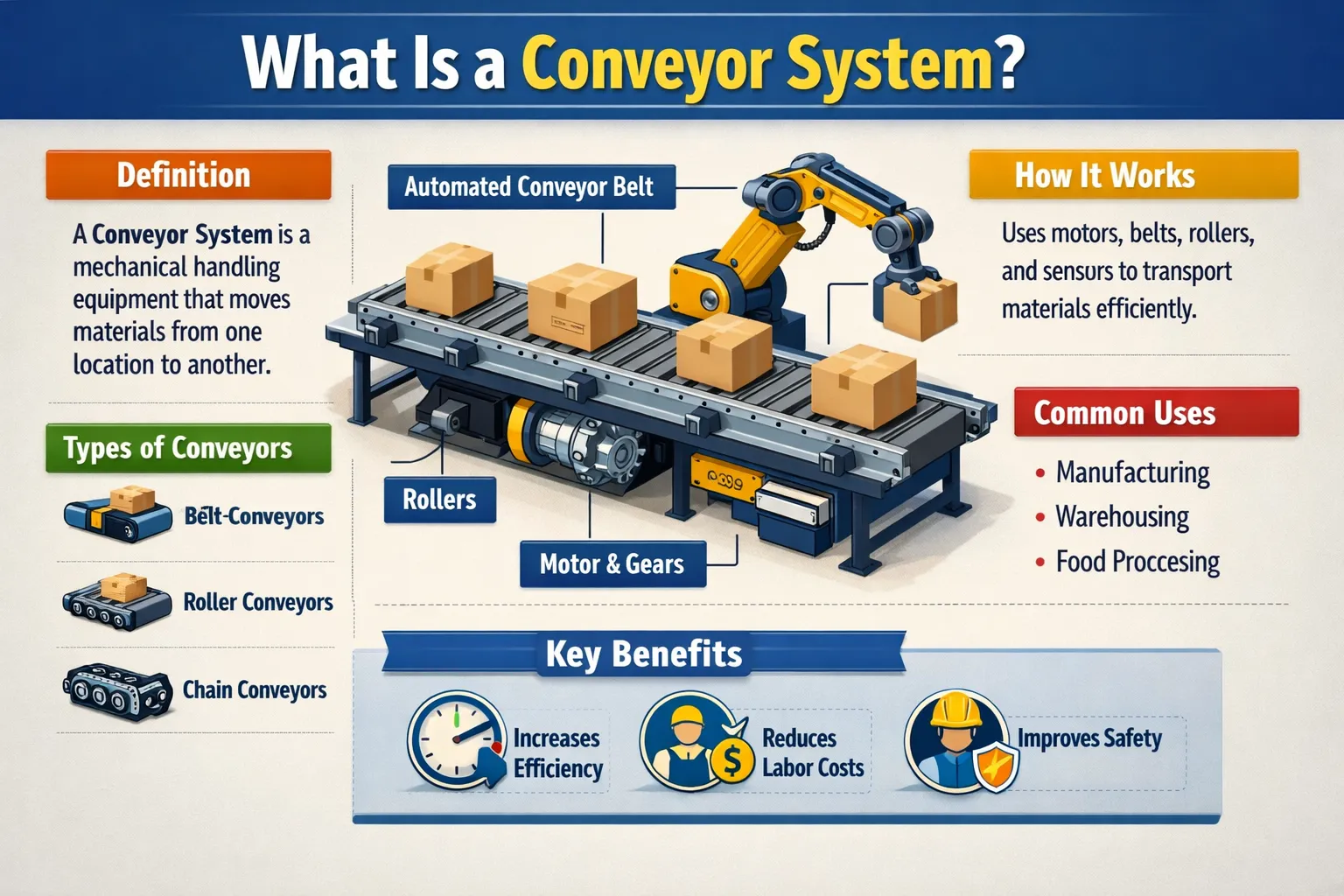
A conveyor system is a mechanical setup designed to move materials from one point to another automatically — without someone carrying them by hand. Think of it like a river current: you place something at one end, and it arrives at the other end without manual effort.
At its simplest, every conveyor system has three components: a frame (the structure), a drive unit (the motor that powers movement), and a conveying surface (the belt, rollers, or chain that actually moves the goods).
That’s why it matters to you: understanding these three parts tells you immediately where a breakdown is likely occurring and who to call when something goes wrong.
Why It’s Not Just a “Moving Belt”
Most people picture a flat rubber belt when they hear “conveyor.” That’s one type — but only one. A conveyor system can move boxes horizontally, tilt items up an incline, sort packages by destination, or even handle loose bulk materials like grain or gravel.
The word “system” is key. In most facilities, conveyors are linked together in a network, not operating as a single standalone unit. Each section feeds the next. If one section slows down, the whole flow is affected.
Chapter takeaway: A conveyor system is an automated material-movement network, not just a single belt.
The Main Types of Conveyor Systems
This is where most beginners get confused — there are dozens of conveyor variants. Here’s a practical breakdown of the types you’re most likely to encounter at work.
Belt vs. Roller vs. Chain: The Big Three
| Type | How It Works | Best For | Common Industries |
|---|---|---|---|
| Belt Conveyor | Continuous loop of flat material driven by a motor | Packaged goods, small items, inclines | E-commerce, food production, airports |
| Roller Conveyor | Series of rotating cylinders; gravity or powered | Boxes, pallets, flat-bottomed items | Warehousing, distribution centers |
| Chain Conveyor | Metal chain links carry heavy loads | Heavy parts, automotive frames | Automotive, heavy manufacturing |
The key difference isn’t just what they look like — it’s load capacity and surface compatibility. A roller conveyor will damage a soft-bottomed bag. A belt conveyor won’t handle a 500 kg engine block. Matching the type to the product is a basic competency for anyone in operations or procurement.
Specialty Types Worth Knowing
Beyond the big three, two types come up frequently in modern facilities:
Screw conveyors (also called auger conveyors) use a rotating helical blade — like a large corkscrew — to push bulk materials such as flour, cement, or grain through a enclosed tube. They’re common in food processing and agriculture.
Overhead conveyors hang from ceiling-mounted tracks and move items through the air. You’ve seen these in dry-cleaning shops — the rotating rack of hanging clothes. In industry, they’re used to move car bodies through paint booths or garment factories to keep floor space clear.
Chapter takeaway: Match the conveyor type to your product’s weight, shape, and fragility — wrong match means damage or downtime.
How Conveyor Systems Are Used Across Industries
Manufacturing and Assembly Lines
In manufacturing, conveyors are the timeline of production. Parts arrive at workstations in sequence, at a controlled speed. Workers or machines perform one task, then the item moves to the next station automatically.
The speed of the conveyor — measured in meters per minute (m/min) — directly controls the production rate. Slow it down, output drops. Speed it up without adjusting downstream stations, and you create bottlenecks. This is why line speed is one of the most closely watched metrics in any plant.
Warehousing, Logistics, and E-Commerce
In a fulfillment center, a single order might travel across five or six conveyor segments: from picking area, to weighing station, to labeling, to sorting, to the dispatch dock. The entire process can take under two minutes — without a single person carrying that package.
Modern systems integrate barcode scanners and sensors directly into the conveyor line. As a package passes a scan point, the system reads its label and activates a diverter (a small mechanism that pushes the package onto a branch conveyor) to route it to the correct destination automatically.
Food, Pharma, and Controlled Environments
In food production and pharmaceutical manufacturing, conveyors must meet strict hygiene standards. That means food-grade belts (made from materials approved for direct food contact), easy-disassembly frames for cleaning, and sometimes fully enclosed designs to prevent contamination.
If you work in these industries, the material specification of the belt — not just the conveyor type — is a compliance issue, not just a performance issue.
Chapter takeaway: The industry you’re in dictates not just which conveyor type you use, but what material and hygiene standards it must meet.
Common Mistakes Beginners Make Around Conveyor Systems
Assuming All Conveyors Are Interchangeable
This is the most common error in early-career operations roles. A belt conveyor isn’t a “safer” version of a roller conveyor — they’re designed for different loads and surfaces. Using the wrong type leads to product damage, excessive wear, and safety incidents.
Before recommending or approving equipment, always confirm: product weight, product dimensions, required throughput rate, and environmental conditions (wet, hot, dusty?).
Ignoring Maintenance Intervals
Conveyor systems look simple, but they have dozens of moving parts — belts stretch, rollers seize, chain links wear. Preventive maintenance intervals (the scheduled service intervals specified by the manufacturer) are not optional suggestions. Missing them is the leading cause of unplanned downtime in production facilities.
A practical rule: if you’re responsible for a conveyor line, locate the maintenance schedule on day one. Don’t wait for something to break.
Chapter takeaway: Wrong type selection and skipped maintenance are the two fastest ways to turn a conveyor into a liability.
What You Should Be Able to Do Now
After reading this, you should be able to:
- Explain what a conveyor system is to a colleague or supplier in plain terms
- Identify the main conveyor types by their appearance and application
- Ask the right questions before a conveyor is selected or replaced in your facility
Immediate action: Next time you’re near a conveyor at work, identify its type using the table above. Then find out what it’s carrying and whether that’s the right match. That 5-minute exercise will stick better than any training module.
Want to go deeper? Look into conveyor system safety standards — specifically OSHA 1910.261 (for industrial conveyors in the US) or the equivalent standard in your region. Understanding safety compliance is the fastest way to add real value in an operations role.
Frequently Asked Questions
Q1: What’s the difference between a powered roller conveyor and a gravity roller conveyor?
A: A powered roller conveyor has motors driving the rollers — items move at a controlled speed regardless of incline. A gravity roller conveyor uses no power; items roll on their own momentum, usually on a slight downward slope. Gravity systems are cheaper and simpler but only work for flat-bottomed items on level or declining paths. Powered systems give you speed control and can handle horizontal runs. For most modern warehouses, powered is the standard choice.
Q2: How do I know if a conveyor system is undersized for a production line?
A: The clearest sign is product accumulation — items backing up at one point because downstream capacity can’t keep up. You can also check the system’s rated throughput (items per minute or kg per hour) against your actual production demand. If your line regularly runs at more than 85% of rated capacity, you’re likely undersized and heading toward reliability problems.
Q3: Do conveyor systems require special operator certification?
A: In most countries, operating a standard conveyor doesn’t require formal certification. However, maintenance personnel often need documented training, and any conveyor integrated with automated machinery (robots, sorters) may fall under machinery safety regulations requiring competency records. Always check your company’s health and safety requirements and the local regulatory framework — don’t assume no certification means no responsibility.
Q4: Can conveyor systems handle outdoor or wet environments?
A: Yes, but the system must be specified for it. Outdoor conveyors need weather-resistant frames (typically stainless steel or coated carbon steel), sealed bearings, and belts rated for UV and moisture exposure. Standard indoor conveyors will rust, degrade, and fail quickly outdoors. If you’re sourcing equipment for an outdoor application, make sure “IP rating” (Ingress Protection — a measure of how well equipment resists dust and water) is part of the specification conversation.
Q5: What’s the realistic lifespan of a conveyor belt?
A: It depends heavily on load, speed, and maintenance quality. A well-maintained belt in a light-duty e-commerce environment might last 5–10 years. A belt in a high-abrasion mining or aggregate application might need replacement every 12–18 months. The manufacturer’s spec sheet will list expected belt life under defined conditions — that’s your baseline. Actual lifespan is mostly a maintenance story, not a product quality one.