
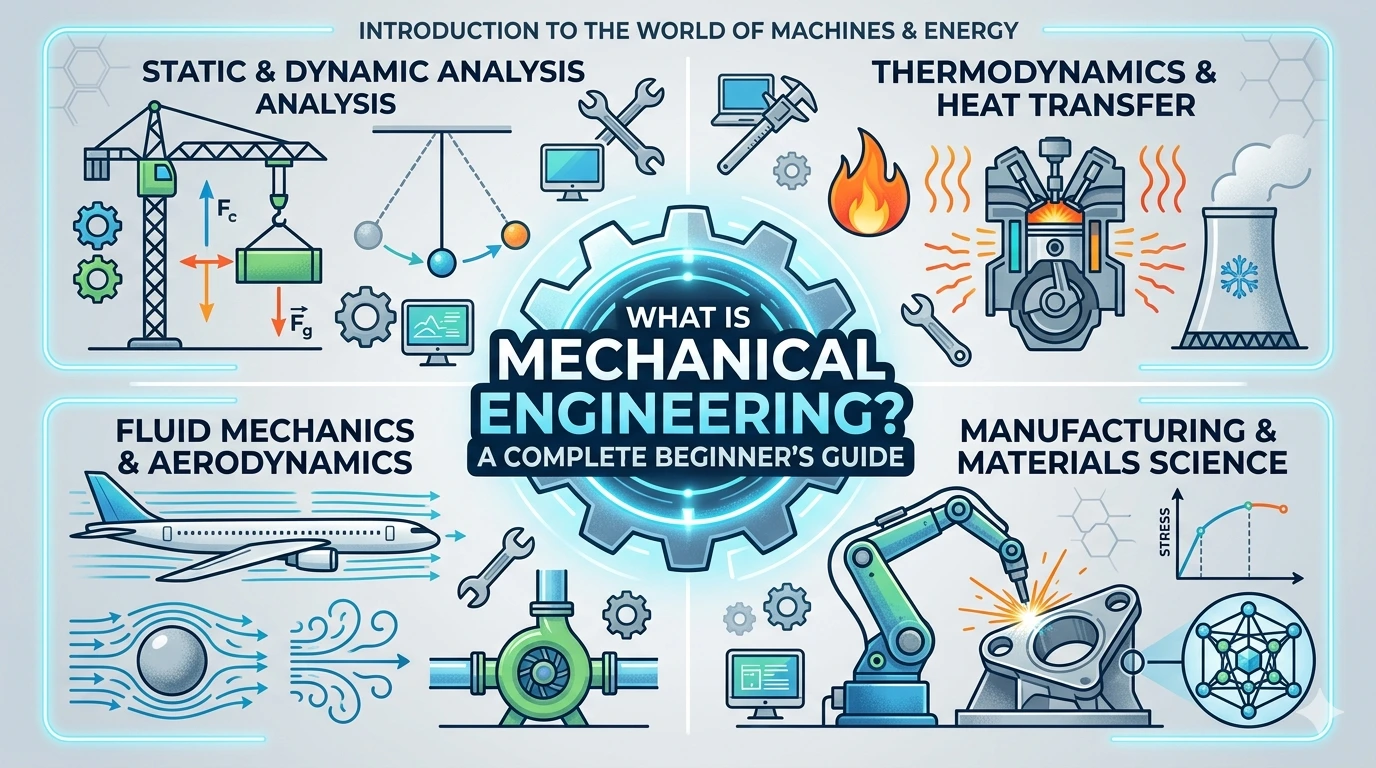
Mechanical engineering is one of the oldest, broadest, and most versatile engineering disciplines in the world. This beginner’s guide explains what mechanical engineering is, what mechanical engineers actually do, what you study, where you can work, and why this field remains one of the most in-demand professions of the 21st century.
Introduction
If you have ever wondered how a car engine works, what keeps an aircraft in the sky, how a wind turbine generates electricity, or why your laptop doesn’t overheat — you are already thinking about mechanical engineering.
Mechanical engineering is the branch of engineering that applies the principles of physics, mathematics, and materials science to design, analyze, manufacture, and maintain mechanical systems. It is one of the broadest engineering disciplines, touching virtually every physical product and industrial process that modern civilization depends on — from microscopic medical implants to massive hydroelectric turbines.
According to the U.S. Bureau of Labor Statistics, mechanical engineering is consistently among the top five largest engineering occupations in the United States, with over 300,000 professionals employed and demand projected to grow steadily through the 2030s. Globally, the discipline employs millions of engineers across automotive, aerospace, energy, robotics, manufacturing, and consumer products industries.
Whether you are a high school student exploring career options, a college freshman deciding on a major, or simply someone curious about what the field involves, this guide will give you a thorough, accessible introduction to mechanical engineering — what it is, how it works, and where it can take you.
1. The Definition of Mechanical Engineering
At its core, mechanical engineering is the discipline concerned with the design, analysis, manufacturing, and operation of systems and devices that involve force, motion, and energy.
The American Society of Mechanical Engineers (ASME) — the profession’s leading global organization — defines mechanical engineering as “the application of the principles of physics and materials science for analysis, design, manufacturing, and maintenance of mechanical systems.”
A more practical way to think about it: if something moves, generates power, transfers heat, or is physically built from materials, there is almost certainly a mechanical engineer involved in its creation.
1.1 The Three Pillars of Mechanical Engineering
Every area of mechanical engineering ultimately rests on three foundational pillars:
Forces and Motion (Mechanics) Understanding how forces act on objects and how objects move in response. This encompasses everything from the stress inside a bridge beam to the trajectory of a satellite.
Energy and Heat (Thermodynamics and Heat Transfer) Understanding how energy is generated, converted, and transferred between systems. This underlies the design of every engine, power plant, HVAC system, and refrigerator on the planet.
Materials and Manufacturing Understanding the properties of metals, plastics, ceramics, and composites — and knowing how to shape them into functional components through machining, casting, welding, 3D printing, and other fabrication methods.
Everything a mechanical engineer designs or analyzes draws on one or more of these three pillars.
2. A Brief History of Mechanical Engineering
Mechanical engineering is as old as human civilization. Long before the profession had a name, humans were applying its principles to build tools, levers, water wheels, and catapults.
2.1 Ancient Origins
The earliest mechanical engineers were the inventors of simple machines. The lever, the wheel and axle, the pulley, the inclined plane, the wedge, and the screw — the six classical simple machines — were all understood and exploited by ancient civilizations in Egypt, Greece, Rome, and China thousands of years ago. Archimedes of Syracuse (287–212 BC) is often cited as history’s first great mechanical engineer, having systematized the theory of the lever and designed elaborate war machines and water-lifting devices.
2.2 The Industrial Revolution
Mechanical engineering as a formal discipline emerged from the Industrial Revolution of the 18th and 19th centuries. The invention of the steam engine — developed and refined by James Watt in the 1760s and 1780s — created an enormous demand for engineers who could design, build, and maintain complex machinery. The Institution of Mechanical Engineers was founded in Birmingham, England in 1847, establishing the profession’s first formal organizational framework. ASME followed in the United States in 1880.
2.3 The 20th Century and Beyond
The 20th century transformed mechanical engineering beyond recognition. The rise of the automobile, the invention of powered flight, the development of jet engines, nuclear power, space exploration, and computer-aided design all required — and in turn shaped — mechanical engineering. Today, the discipline is evolving once again under the influence of digital manufacturing, robotics, artificial intelligence, and sustainable energy systems.
3. Core Subjects in Mechanical Engineering
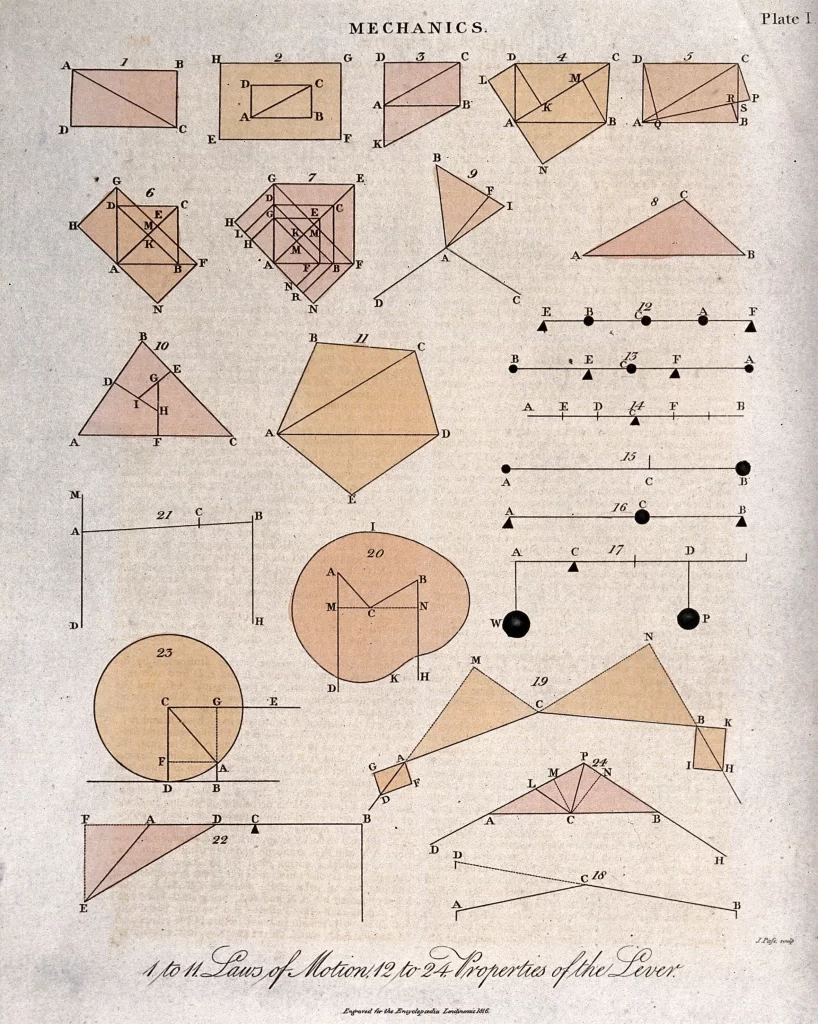
A typical mechanical engineering degree program covers a wide range of technical subjects. Understanding these core areas helps explain both the depth and the breadth of the discipline.
3.1 Statics and Dynamics
Statics studies objects and structures that are in equilibrium — not moving or accelerating. Engineers use statics to calculate the forces acting on beams, trusses, frames, and machine components to ensure they will not fail under load. Dynamics extends this to objects in motion, analyzing how forces cause acceleration and how systems like rotating machinery or vehicles behave over time.
3.2 Mechanics of Materials (Strength of Materials)
This subject examines how solid objects deform and fail under applied loads. Concepts like stress, strain, bending moments, torsion, fatigue, and fracture mechanics are all covered here. A mechanical engineer designing a connecting rod for an engine or a structural bracket for an aircraft must understand exactly how much load the component can carry before it yields or breaks.
3.3 Thermodynamics
Thermodynamics is the science of energy — specifically, the conversion of heat into work and vice versa. It governs the operation of every heat engine (car engines, steam turbines, jet engines), every refrigeration cycle (air conditioners, refrigerators), and every power plant on earth. The famous laws of thermodynamics — conservation of energy, the direction of heat flow, and the limits of efficiency — are foundational knowledge for any mechanical engineer working with energy systems.
3.4 Fluid Mechanics
Fluid mechanics covers the behavior of liquids and gases under various conditions. It explains how water flows through a pipe, how lift is generated by an aircraft wing, how a centrifugal pump moves fluid, and how combustion gases flow through a turbine. Computational fluid dynamics (CFD) — the simulation of fluid behavior using computers — has become an indispensable tool in modern mechanical engineering design.
3.5 Heat Transfer
Closely linked to thermodynamics, heat transfer specifically examines the mechanisms by which thermal energy moves from one place to another — by conduction (through solids), convection (through fluids), and radiation (through electromagnetic waves). Mechanical engineers use heat transfer principles to design cooling systems for electronics, heat exchangers for industrial processes, and thermal management systems for vehicles and spacecraft.
3.6 Manufacturing Processes
Understanding how parts are physically made is a core competency in mechanical engineering. This subject covers a wide range of fabrication methods including casting, forging, machining (turning, milling, drilling), welding, sheet metal forming, injection molding, powder metallurgy, and additive manufacturing (3D printing). A design that cannot be manufactured economically is not a good design, regardless of its theoretical elegance.
3.7 Machine Design and Theory of Machines
Machine design integrates the preceding subjects into a practical framework for designing mechanical components and systems. It covers the design of gears, bearings, shafts, fasteners, springs, clutches, brakes, and complete assemblies. Theory of machines examines how mechanisms — linkages, cams, gears — convert motion from one type to another, which is fundamental to designing everything from robotic arms to automobile valve trains.
3.8 Control Systems
Modern mechanical engineering is inseparable from control theory. Control systems govern how machines respond to inputs and disturbances — how a thermostat maintains temperature, how a CNC machine follows a programmed path, how an autonomous vehicle maintains its lane. Feedback control, PID controllers, and system stability analysis are all part of the modern mechanical engineer’s toolkit.
3.9 Engineering Mathematics
Underpinning all of the above is a rigorous mathematical foundation: calculus, differential equations, linear algebra, numerical methods, and statistics. These tools allow mechanical engineers to model physical systems mathematically, solve complex equations, and interpret data from experiments and simulations.
4. Key Branches and Specializations of Mechanical Engineering
One of the most remarkable characteristics of mechanical engineering is its breadth. The discipline has given rise to numerous specialized sub-fields, each representing a distinct career path and body of knowledge.
4.1 Automotive Engineering
Automotive engineers design and develop vehicles — cars, trucks, motorcycles, and off-road equipment. Their work spans powertrains (engines and transmissions), chassis and suspension systems, aerodynamics, safety structures, and increasingly, electric and hybrid propulsion systems. The shift toward electric vehicles (EVs) and autonomous driving has made automotive engineering one of the most rapidly evolving specializations in mechanical engineering today.
4.2 Aerospace Engineering
Aerospace engineers apply mechanical engineering principles to the design of aircraft, spacecraft, rockets, and satellites. This specialization demands deep expertise in aerodynamics, structural analysis (particularly fatigue and fracture under cyclic loading), propulsion systems, and materials science. Aerospace is one of the most technically demanding and prestigious branches of the discipline.
4.3 Manufacturing and Industrial Engineering
Manufacturing engineers focus on the processes, equipment, and systems used to produce physical goods at scale. They design production lines, optimize manufacturing workflows, implement quality control systems, and introduce automation and robotics to improve productivity. This branch of mechanical engineering is directly responsible for the efficiency and cost competitiveness of virtually every product on the market.
4.4 Energy and Power Systems Engineering
This specialization covers the generation, conversion, and distribution of energy. Mechanical engineers in this field design gas turbines, steam generators, wind turbines, solar thermal systems, nuclear reactor components, and hydraulic power systems. With the global energy transition accelerating, this is one of the fastest-growing areas of mechanical engineering.
4.5 Robotics and Mechatronics
Mechatronics — the integration of mechanical engineering, electrical engineering, and computer science — is the foundation of modern robotics. Mechanical engineers in this field design robotic manipulators, actuators, sensors, and the mechanical structures of automated systems. The explosive growth of industrial automation, collaborative robots (cobots), and autonomous vehicles has made mechatronics one of the most sought-after specializations in the profession.
4.6 Biomedical Engineering
Biomedical engineering applies mechanical engineering principles to medical devices and biological systems. Mechanical engineers in this field design prosthetic limbs, orthopedic implants, surgical instruments, medical imaging equipment, and drug delivery systems. The intersection of mechanics, materials, and biology creates unique design challenges that demand both deep technical knowledge and an understanding of human physiology.
4.7 HVAC and Building Systems Engineering
Heating, ventilation, air conditioning, and refrigeration (HVAC/R) systems represent a massive and essential application of mechanical engineering. Engineers in this field design climate control systems for buildings, hospitals, data centers, and vehicles — balancing thermal comfort, energy efficiency, air quality, and reliability. HVAC engineers are in constant demand as buildings grow more complex and energy efficiency requirements become more stringent.
4.8 Thermal and Fluid Systems
Some mechanical engineers specialize specifically in thermal-fluid systems: heat exchangers, boilers, condensers, pumps, compressors, and piping systems. These engineers are found in power generation, chemical processing, oil and gas, food and beverage, and pharmaceutical manufacturing industries.
5. What Do Mechanical Engineers Actually Do?
Understanding what mechanical engineers do on a day-to-day basis helps demystify the profession and sets realistic expectations for anyone considering the field.
5.1 Design and Analysis
The most visible part of a mechanical engineer’s work is design — creating new products, components, or systems. Modern design relies heavily on Computer-Aided Design (CAD) software such as SolidWorks, CATIA, Siemens NX, and Autodesk Inventor, which allow engineers to build detailed 3D models of components and assemblies. These models feed into Finite Element Analysis (FEA) software that simulates how a design will behave under load, heat, or vibration — allowing engineers to identify weaknesses and optimize designs before a single physical prototype is built.
5.2 Testing and Validation
Before any product reaches a customer, it must be tested to confirm it performs as designed. Mechanical engineers design test rigs, develop test procedures, instrument components with sensors, run tests, collect data, and analyze results. Testing may range from simple tensile tests of material specimens to full-scale fatigue testing of aircraft structures or emissions testing of vehicle engines.
5.3 Manufacturing Support
In production environments, mechanical engineers work closely with manufacturing teams to ensure designs can be produced to specification, troubleshoot production problems, qualify new suppliers, and implement process improvements. This role — often called manufacturing engineer or process engineer — is critical to maintaining product quality and production efficiency.
5.4 Project and Systems Management
Many senior mechanical engineers move into project management roles, overseeing teams of engineers, managing budgets and schedules, coordinating with suppliers and customers, and ensuring that complex engineering projects are delivered on time and within scope. The analytical and problem-solving skills developed through technical engineering work translate well into management responsibilities.
5.5 Research and Development
At the cutting edge of the profession, mechanical engineers in R&D roles are developing the next generation of technologies: advanced materials, novel manufacturing processes, more efficient energy conversion systems, and entirely new categories of products. R&D engineers typically work in corporate research centers, national laboratories, or university settings, often collaborating with scientists and engineers from other disciplines.
6. Mechanical Engineering Career Paths and Industries
The versatility of mechanical engineering is perhaps its greatest asset as a career choice. A mechanical engineering degree opens doors in an exceptionally wide range of industries and roles.
6.1 Industries That Hire Mechanical Engineers
- Automotive: vehicle design, powertrain development, safety systems, EV technology
- Aerospace and Defense: aircraft structures, propulsion, spacecraft systems, weapons systems
- Oil, Gas, and Energy: drilling equipment, pipelines, turbines, renewable energy systems
- Consumer Products: appliances, sporting goods, electronics hardware, packaging machinery
- Medical Devices: implants, surgical tools, diagnostic equipment, rehabilitation devices
- Industrial Machinery: pumps, compressors, conveyors, presses, machine tools
- Construction and Infrastructure: heavy equipment, structural systems, building services
- Robotics and Automation: industrial robots, autonomous systems, warehouse automation
- HVAC and Building Systems: commercial and residential climate control systems
- Government and Research: national laboratories, military, space agencies, regulatory bodies
6.2 Common Job Titles
Graduates with a mechanical engineering degree pursue roles with titles such as:
- Mechanical Engineer
- Design Engineer
- Structural Engineer
- Manufacturing Engineer
- Process Engineer
- Product Development Engineer
- Systems Engineer
- Project Engineer
- R&D Engineer
- Thermal / CFD Engineer
- Robotics Engineer
- Quality Engineer
7. Mechanical Engineering Salary and Job Outlook
7.1 Salary Overview
Mechanical engineering offers competitive compensation at every career stage. According to U.S. Bureau of Labor Statistics data:
| Career Stage | Approximate Annual Salary (USA) |
|---|---|
| Entry-level (0–3 years) | $65,000 – $80,000 |
| Mid-career (4–9 years) | $80,000 – $110,000 |
| Senior (10+ years) | $110,000 – $150,000+ |
| Principal / Lead Engineer | $130,000 – $180,000+ |
| Engineering Manager | $140,000 – $200,000+ |
Salaries vary significantly by industry, geography, company size, and specialization. Aerospace, oil and gas, and semiconductor equipment industries typically offer the highest compensation packages. Geographic hotspots for high mechanical engineering salaries include California’s Bay Area, Houston, Seattle, and the greater Boston area.
Internationally, mechanical engineering salaries are strong in Germany, Switzerland, Australia, Canada, Singapore, and the UAE, reflecting the global demand for qualified engineers.
7.2 Job Outlook
The U.S. Bureau of Labor Statistics projects approximately 11% employment growth for mechanical engineers through 2032 — faster than the average for all occupations. Key drivers of this growth include:
- The transition to electric vehicles, requiring redesign of drivetrains, thermal management, and chassis systems
- Expanding renewable energy infrastructure demanding turbine, heat exchanger, and power systems expertise
- Growth of industrial robotics and automation across manufacturing sectors
- Aging infrastructure requiring design and rehabilitation of mechanical systems
- Medical device innovation driven by an aging global population
8. How to Become a Mechanical Engineer
8.1 Education Requirements
The standard entry point for professional mechanical engineering practice is a four-year Bachelor of Science in Mechanical Engineering (BSME) from an accredited university. In the United States, accreditation is provided by ABET (Accreditation Board for Engineering and Technology). In the UK, accreditation is provided by the Institution of Mechanical Engineers (IMechE). Equivalent accreditation bodies exist in most countries.
A typical BSME curriculum includes:
- Years 1–2: Mathematics (calculus, differential equations, linear algebra), physics, chemistry, introduction to engineering design, and computer programming
- Years 3–4: Core engineering subjects (statics, dynamics, thermodynamics, fluid mechanics, heat transfer, materials, manufacturing), technical electives in a chosen specialization, and a capstone design project
8.2 Graduate Education
Many mechanical engineers pursue a Master of Science (MS) or Doctor of Philosophy (PhD) after completing their bachelor’s degree. A master’s degree typically takes one to two years and provides deeper specialization in areas such as robotics, thermal systems, or computational mechanics. A PhD (three to five years beyond the bachelor’s) is required for independent research careers in academia or corporate R&D.
8.3 Professional Licensure
In many countries, practicing as a licensed Professional Engineer (PE) requires passing a professional licensing examination in addition to holding an accredited degree and accumulating work experience. In the United States, this involves passing the Fundamentals of Engineering (FE) exam during or shortly after completing the bachelor’s degree, followed by the Principles and Practice of Engineering (PE) exam after four years of professional experience. PE licensure is required to sign off on engineering documents for public use and is particularly important in consulting, government, and infrastructure roles.
8.4 Key Skills for Success
Beyond formal education, successful mechanical engineers typically possess:
- Analytical thinking: the ability to break complex problems into manageable components and reason through solutions systematically
- Spatial reasoning: the ability to visualize three-dimensional objects and understand how components fit together and move
- Attention to detail: engineering errors can have serious consequences; precision and thoroughness are essential
- Communication skills: engineers must explain technical concepts clearly to colleagues, managers, clients, and non-technical stakeholders
- Curiosity and continuous learning: technology evolves rapidly, and the best engineers are those who never stop learning
9. Mechanical Engineering in the Modern World
9.1 The Digital Revolution in Mechanical Engineering
Modern mechanical engineering practice has been transformed by digital tools. CAD software has replaced drafting boards. FEA and CFD simulation have dramatically reduced the cost and time of design iteration. Digital twins — virtual replicas of physical systems that update in real time based on sensor data — are enabling predictive maintenance and real-time optimization of complex machinery. Additive manufacturing (3D printing) is enabling geometries and material combinations that were previously impossible to fabricate.
9.2 Mechanical Engineering and Sustainability
The challenge of building a sustainable global economy places mechanical engineering at the center of some of the most important problems of the 21st century. Mechanical engineers are designing more efficient combustion engines, developing next-generation wind and tidal turbines, creating lightweight vehicle structures that reduce fuel consumption, designing solar thermal power plants, and developing carbon capture systems. The discipline’s deep expertise in energy conversion and materials makes it indispensable in the transition to a low-carbon economy.
9.3 The Intersection with Other Disciplines
Mechanical engineering increasingly overlaps and collaborates with other fields. The boundary between mechanical and electrical engineering has blurred significantly with the rise of mechatronics and smart systems. Mechanical engineers work closely with materials scientists on advanced composites and nanomaterials. The intersection with computer science is generating entirely new fields like computational mechanics and digital manufacturing. This interdisciplinary trend makes mechanical engineering graduates more versatile than ever.
10. Frequently Asked Questions About Mechanical Engineering
Is mechanical engineering hard?
Mechanical engineering is widely considered one of the more challenging undergraduate degree programs. The combination of rigorous mathematics, abstract physical concepts, and the need to apply them to practical design problems demands sustained effort. That said, students who have strong mathematical foundations, genuine curiosity about how things work, and persistence consistently succeed in the field. The difficulty is real, but so is the reward.
Is mechanical engineering a good career in 2025?
Yes. Mechanical engineering remains one of the most secure and well-compensated career choices available. The breadth of the discipline means that mechanical engineers are employed across virtually every industry sector, providing career resilience that narrower specializations cannot match. Emerging fields like electric vehicles, renewable energy, robotics, and medical devices are creating strong demand for mechanical engineering skills specifically.
What is the difference between mechanical engineering and civil engineering?
Both disciplines apply engineering principles to physical systems, but they focus on different domains. Mechanical engineering deals primarily with moving systems, machines, and energy — engines, turbines, robots, vehicles, HVAC systems. Civil engineering focuses on stationary infrastructure — buildings, bridges, roads, dams, and water supply systems. There is overlap in areas like structural analysis and materials, but the day-to-day work and career paths are quite distinct.
Do mechanical engineers use a lot of math?
Yes — mathematics is the language of mechanical engineering. Calculus, differential equations, and linear algebra are used routinely in analyzing physical systems. Numerical methods and statistical analysis are used extensively in simulation and data analysis work. Engineers who are comfortable with mathematics are generally more effective and have more career options than those who avoid it.
Can mechanical engineers work in software?
Increasingly, yes. Many mechanical engineers develop deep expertise in simulation software (FEA, CFD), CAD programming, or embedded systems software and transition into roles that blend engineering and software development. The rise of digital manufacturing and cyber-physical systems has created a growing demand for engineers who understand both the physical world and the software that models and controls it.
Conclusion
Mechanical engineering is a discipline of remarkable depth and breadth — grounded in timeless physical principles yet continuously reinvented by new technologies and challenges. From the steam engines of the Industrial Revolution to the electric vehicles, surgical robots, and wind turbines of today, mechanical engineering has been the discipline that turns scientific understanding into the machines and systems that power modern life.
For anyone considering a career in the field, the case is compelling: strong and growing demand, competitive salaries, extraordinary variety of industries and roles, and the genuine satisfaction of building things that work. The challenges are real — the coursework is demanding, the standards are high, and the problems are genuinely hard. But that is precisely what makes mechanical engineering one of the most rewarding professions a technically minded person can pursue.
Whether your interest lies in designing faster cars, cleaner power plants, smarter robots, or life-saving medical devices, mechanical engineering offers a pathway to do work that is technically rigorous, practically meaningful, and genuinely important.
Quick Reference: Mechanical Engineering at a Glance
| Category | Key Facts |
|---|---|
| Core definition | Design, analysis, manufacture, and operation of mechanical systems |
| Foundational subjects | Mechanics, thermodynamics, fluid mechanics, materials, manufacturing |
| Degree required | BS in Mechanical Engineering (4 years); MS/PhD for advanced roles |
| Licensure | PE license (USA); CEng (UK); equivalent in other countries |
| Typical starting salary (USA) | $65,000 – $80,000 |
| Top industries | Automotive, aerospace, energy, robotics, medical devices, HVAC |
| Job growth outlook | ~11% through 2032 (U.S. BLS) |
| Key professional organization | ASME (American Society of Mechanical Engineers) |