
Why Friction Force Matters Before You Touch Any Machine
You’re reviewing a conveyor belt system that keeps slipping under load — and your supervisor asks why. If you can’t explain friction force, you can’t solve the problem. That’s the gap this article closes.
By the end of this guide, you’ll understand what friction force is, how its four main types behave differently, and where engineers account for it in real equipment decisions.
Here’s a grounding fact: friction accounts for roughly 20–30% of all energy losses in mechanical systems, according to industrial tribology research. That’s not a minor detail — it’s a significant cost driver in manufacturing and logistics.
Let’s break it down in plain terms.
What Is Friction Force, Exactly?
The Core Definition (No Jargon)
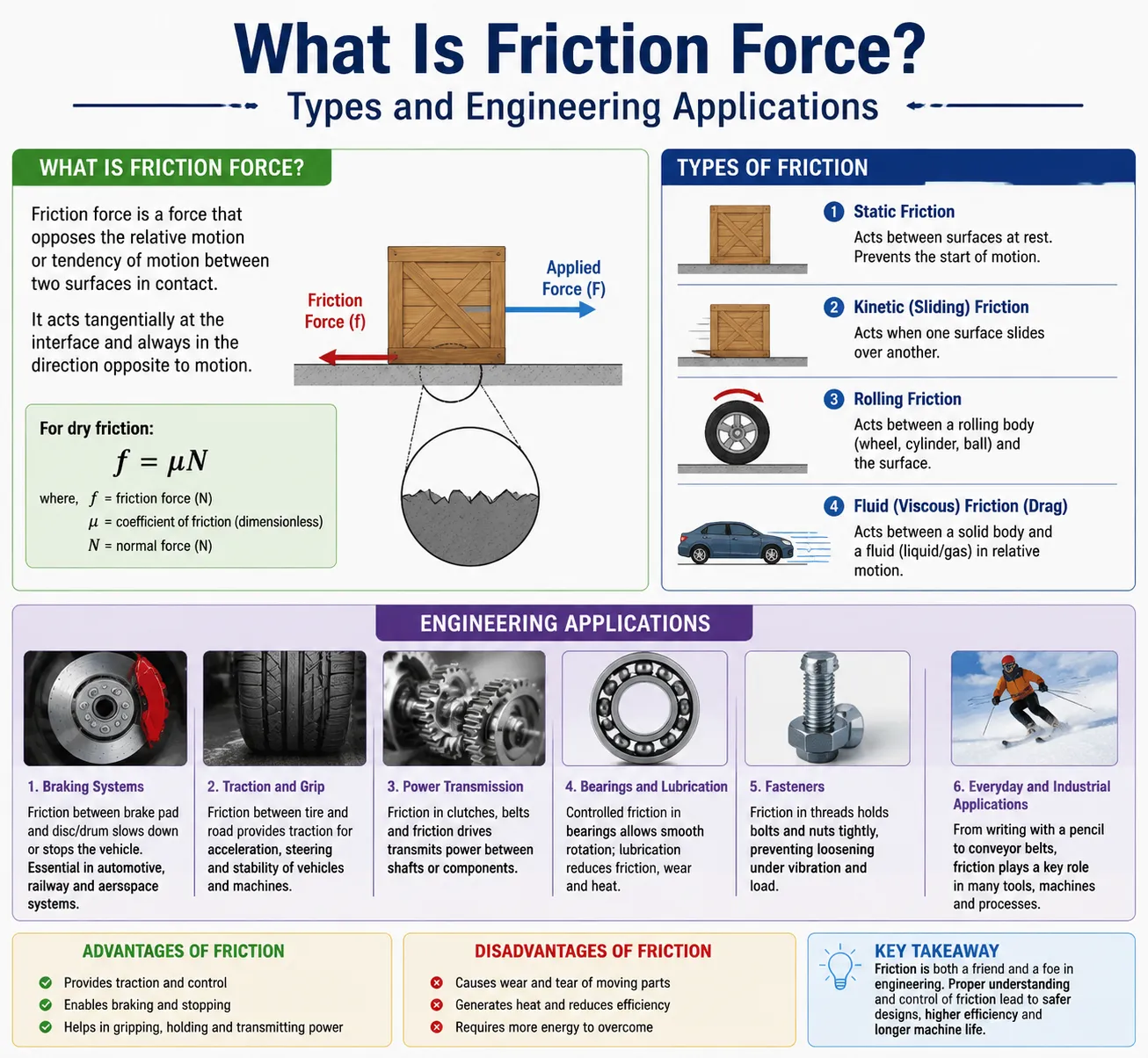
Friction force is the resistance force that acts between two surfaces in contact when one tries to move against the other. Think of it like this: when you slide a cardboard box across a concrete floor, the floor “pushes back” against the motion. That pushback is friction force.
It always acts in the opposite direction of motion or intended motion. You can’t see it, but you feel it every time you brake a car or grip a wrench.
Why this matters for you: Misunderstanding friction leads to undersized motors, overheated components, and unexpected equipment failures.
How It’s Calculated
The basic formula is:
F = μ × N
| Term | Plain Meaning | Typical Range |
|---|---|---|
| F | Friction force (in Newtons) | Depends on surface and load |
| μ (mu) | Coefficient of friction (a dimensionless ratio of how “grippy” two surfaces are) | 0.01 (ice on ice) to 0.8 (rubber on concrete) |
| N | Normal force (the perpendicular force pressing the surfaces together) | Equals object weight on flat surfaces |
Key takeaway: Friction force scales directly with how hard two surfaces press together — not with contact area. A heavy machine on a small pad creates the same friction as the same machine on a large pad, assuming identical surfaces.
The Four Types of Friction Force
Static Friction — The “Before It Moves” Force
Static friction (the resistance that prevents an object from starting to move) is always higher than the friction once motion begins. This is why it’s harder to start pushing a heavy pallet than to keep it moving.
Engineers designing conveyor startups or robotic arms must overcome static friction first. Ignore it, and your motor stalls at startup.
Kinetic Friction — The “While It’s Moving” Force
Kinetic friction (resistance between surfaces already in relative motion) is lower and more predictable than static friction. It’s the force your brake pads fight against when you’re decelerating.
In manufacturing, kinetic friction affects heat generation in bearings, wear rate on sliding components, and energy efficiency of linear actuators.
Rolling Friction — Why Wheels Exist
Rolling friction (resistance caused by a wheel or cylinder rolling over a surface) is dramatically lower than sliding friction. That’s the entire engineering reason wheels were invented.
A steel wheel on a steel rail has a friction coefficient of about 0.001–0.003 — compared to 0.3–0.5 for rubber sliding on asphalt. This difference is why rail transport is far more energy-efficient than road transport.
Fluid Friction — Resistance Inside Liquids and Gases
Fluid friction (resistance within a fluid when layers move at different speeds) governs hydraulic systems, lubricated bearings, and aerodynamic drag. This is why oil viscosity matters in a gearbox — thicker oil creates more internal resistance, affecting efficiency and heat.
Key takeaway: Choosing the right friction type for a design application is not optional — it determines energy consumption, component lifespan, and safety margins.
How Engineers Apply Friction Force in Real Systems
When You Want More Friction
Braking systems, clutches, conveyor belts gripping products, non-slip flooring, and bolt joints all rely on maximizing friction force. Engineers select high-μ materials (rubber, textured metals, friction pads) and increase normal force through clamping or preload.
A bolted flange joint, for example, is designed so that friction between the mating surfaces carries the shear load — not the bolt itself. Get the friction calculation wrong, and the joint slips.
When You Want Less Friction
Bearings, slideways, gears, and any rotating or sliding interface need minimized friction to reduce heat, wear, and power loss. Solutions include:
- Lubrication — reduces kinetic friction by separating surfaces with a fluid film
- Surface finishing — polished surfaces have lower μ than rough ones
- Material pairing — e.g., PTFE (Teflon) against steel gives μ ≈ 0.04
Common Engineering Mistakes Around Friction
Mistake 1: Assuming friction is constant. Temperature, surface contamination, and wear all change μ over time. A brake that works at room temperature may fade under heat.
Mistake 2: Ignoring static friction in motor sizing. Motors sized only for running load often fail to start under full load because they can’t overcome static friction at startup.
Mistake 3: Over-lubricating. Too much lubricant can cause hydroplaning in bearings or contaminate friction surfaces (like clutch plates), reducing grip where you need it most.
Key takeaway: Friction force is not a fixed number — it’s a variable that changes with conditions, and engineering decisions must account for that range.
What You Can Do With This Knowledge Now
You’ve now covered what friction force is, how its four types behave, and where engineers deliberately increase or decrease it. You should be able to:
- Explain why a motor might stall at startup (static friction peak)
- Identify whether a system problem relates to too much or too little friction
- Read a friction coefficient table and understand what the numbers mean
Immediate action: Next time you’re near a piece of moving equipment, identify one surface pair and ask: is friction being maximized or minimized here, and how? This single habit builds mechanical intuition fast.
Extend your learning: Study tribology basics — the science of friction, wear, and lubrication. The Society of Tribologists and Lubrication Engineers (STLE) publishes free introductory resources online.
Frequently Asked Questions
Q1: Is higher friction always bad for machinery?
Not at all. It depends entirely on function. Brakes, clutches, conveyor drives, and bolted joints all need high friction to work. The goal is never to minimize friction everywhere — it’s to control it precisely where each application requires. Engineers deliberately select high-friction materials for grip surfaces and low-friction materials for sliding interfaces within the same machine.
Q2: How does lubrication actually reduce friction — does it just make things slippery?
Lubrication works by creating a thin fluid film between surfaces, preventing direct contact. When surfaces don’t touch, kinetic friction drops dramatically because the resistance becomes fluid friction (which is far lower). The lubricant’s viscosity — its thickness — determines how effective this film is. Too thin and the film breaks down; too thick and internal fluid resistance wastes energy.
Q3: Can friction force exist without motion?
Yes — that’s exactly what static friction is. Two surfaces can exert significant friction force on each other while remaining completely still. A book sitting on a tilted board without sliding is held in place by static friction. Engineers must calculate this “pre-motion” resistance whenever designing systems that need to hold position under load.
Q4: Why does rubber have such a high friction coefficient compared to metal?
Rubber is viscoelastic — it deforms slightly under contact and “grips” microscopic surface irregularities. This mechanical interlocking creates much higher resistance than rigid metal-on-metal contact. That’s why tire design is a serious engineering discipline: grip depends on rubber compound, tread pattern, temperature, and surface texture all interacting simultaneously.
Q5: How do I know which friction type applies to a system I’m analyzing?
Use this quick check: Is there relative motion? If no → static friction. If yes, is it sliding? → kinetic friction. Rolling? → rolling friction. Is a fluid involved as the medium? → fluid friction. Most real systems involve more than one type simultaneously — a rolling bearing, for example, involves both rolling and fluid friction when lubricated.