You walk onto a shop floor for the first time. Someone points at a massive machine slowly crushing a metal sheet into a car door panel. They call it a hydraulic press. You nod, but you have no idea what just happened or why that machine was chosen over ten other options on the floor.
That confusion is normal. Most people entering manufacturing, automotive, or industrial roles face the same gap.
By the end of this article, you’ll understand what a hydraulic press is, how it generates force, where it’s commonly used, and how to spot the difference between press types. One fact worth knowing upfront: a hydraulic press can multiply input force by a factor of 100 or more, depending on its cylinder design. That single principle explains almost everything else about how this machine works.
Keep reading, because once you understand the core mechanism, every technical spec sheet you encounter afterward will make far more sense.
What Is a Hydraulic Press
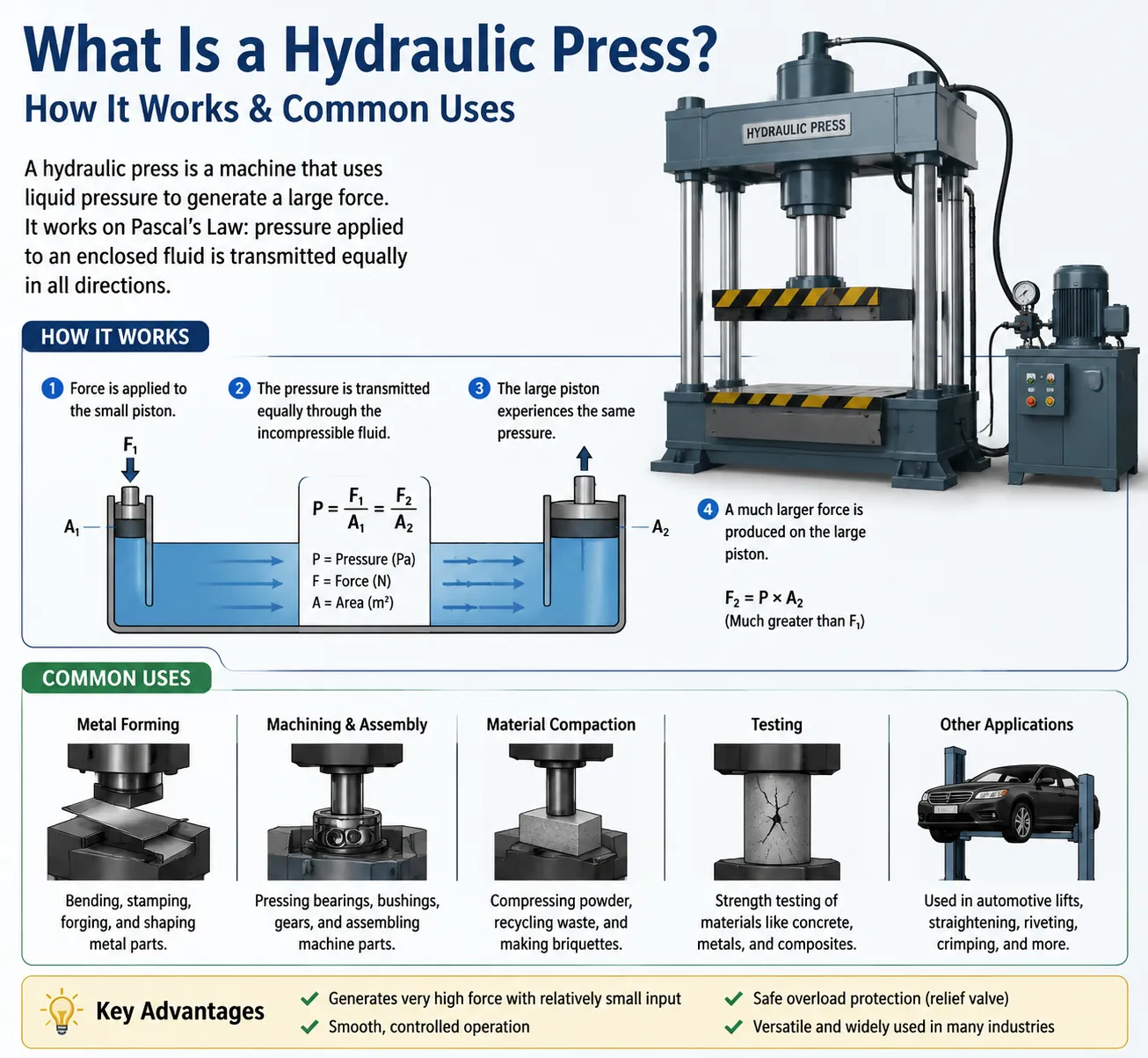
A hydraulic press is a machine that uses liquid pressure (force transmitted through an incompressible fluid, usually oil) to compress, shape, or punch materials. It relies on a basic physics principle: pressure applied to a small area creates a much larger force when transferred to a bigger area.
The Core Mechanism
Picture two connected cylinders filled with oil, one small and one large. Push down on the small cylinder, and the force multiplies as it pushes up the large cylinder. This is called Pascal’s Law (a principle stating that pressure in a sealed fluid spreads equally in all directions). It’s the same idea behind a car jack, just scaled up dramatically.
Why this matters to you: this is why a hydraulic press can crush steel with a motor far smaller than you’d expect. The machine doesn’t rely on raw motor power. It relies on smart force distribution.
Key Components You’ll Hear About
Every hydraulic press includes a few core parts: a hydraulic cylinder, a piston, a pump, and a frame. The pump moves oil into the cylinder. The piston converts that oil pressure into mechanical force. The frame holds everything together under extreme stress.
Why this matters to you: when a technician mentions a “cylinder failure” or “pump issue,” you’ll now know exactly which part of the system they mean.
Section takeaway: A hydraulic press multiplies small input force into massive output force using pressurized fluid, not brute motor strength.
Why Hydraulic Presses Matter in Manufacturing
Hydraulic presses matter because they deliver consistent, controllable force at a scale few other machines can match. That consistency is what makes mass production possible.
Force and Precision Together
A mechanical press (one driven by flywheels and gears instead of fluid) hits hard but can be harder to control mid-stroke. A hydraulic press lets operators adjust pressure and speed throughout the entire motion. This control matters when you’re shaping delicate or layered materials.
Why this matters to you: if your job involves quality control, this is often why hydraulic presses get chosen for parts where consistency affects safety, like brake components.
Tonnage: The Number Everyone Asks About
Tonnage (the maximum force a press can apply, measured in tons) is the first spec anyone checks. A small bench press might run 5 to 20 tons. An industrial forging press can exceed 10,000 tons.
| Press Type | Typical Tonnage Range | Common Use |
|---|---|---|
| Bench/Lab Press | 5–20 tons | Sample testing, small parts |
| Shop Press | 20–100 tons | Bearing removal, light forming |
| Industrial Press | 100–2,000 tons | Sheet metal stamping |
| Forging Press | 2,000–10,000+ tons | Heavy forging, aerospace parts |
Why this matters to you: matching tonnage to the job prevents both wasted capacity and machine damage from underpowered equipment.
Section takeaway: Hydraulic presses dominate manufacturing because they combine huge force with precise, adjustable control.
How to Identify Different Hydraulic Press Types
Not all hydraulic presses look or function the same way. Knowing the main categories helps you understand equipment specs without guessing.
By Frame Structure
Two common frame types exist: H-frame and C-frame. An H-frame press (shaped like the letter H, open on both sides) suits larger parts and higher tonnage. A C-frame press (shaped like the letter C, open on one side) allows easier side-loading for smaller parts.
Why this matters to you: frame shape often tells you the press’s intended part size before you even check the spec sheet.
By Function
Presses are also grouped by what they do: forming, punching, forging, or molding. A forming press shapes metal sheets. A punching press cuts holes or shapes through material. A forging press compresses heated metal into dense, strong parts.
Why this matters to you: the function tells you what industry the press likely serves, whether that’s automotive stamping or aerospace forging.
Section takeaway: Frame shape tells you part size capacity, while function tells you the press’s job on the production line.
Common Mistakes Beginners Make
Many newcomers misjudge hydraulic press capability or safety needs, leading to costly errors early in their careers.
Confusing Tonnage with Speed
A higher tonnage rating doesn’t mean a faster machine. Tonnage measures force, not cycle speed. Some high-tonnage presses run slower because of the volume of fluid being moved.
Why this matters to you: if your production line needs speed over raw force, tonnage alone won’t tell you what you need to know.
Underestimating Maintenance Needs
Hydraulic systems depend on clean fluid and sealed components. Contaminated oil or worn seals cause most press failures, not mechanical wear on the frame itself.
Why this matters to you: asking about fluid maintenance schedules during equipment evaluation can save you from inheriting a problem machine.
Section takeaway: Most beginner mistakes come from focusing on force numbers while ignoring fluid maintenance and speed requirements.
Putting It Into Practice
Learn this article and you should now be able to explain what a hydraulic press does, recognize its main components, and read a basic tonnage spec sheet with confidence.
Your next action: find a tonnage chart for your specific industry (automotive, aerospace, or general fabrication) and compare it against the parts you actually work with. This turns abstract numbers into practical judgment.
For deeper learning, look into fluid power systems and basic hydraulics principles. Understanding pump types and fluid viscosity will make you fluent in conversations about press performance and maintenance.
Frequently Asked Questions
Q1: What’s the difference between a hydraulic press and a mechanical press?
A: A hydraulic press uses pressurized fluid to generate force, giving smooth, adjustable pressure throughout the stroke. A mechanical press uses flywheels and mechanical linkages, delivering fast, fixed-force strikes. Hydraulic presses suit precision work and variable materials. Mechanical presses suit high-speed repetitive stamping where consistent stroke timing matters more than adjustable force control.
Q2: Can a hydraulic press be used at home or in a small workshop?
A: Yes. Smaller bench and shop presses, typically under 50 tons, are common in home workshops for bearing removal, metal bending, and small fabrication projects. They require less space and simpler setup than industrial models. Always check local electrical and ventilation requirements before installing one in a garage or small workspace.
Q3: What safety certifications should I look for when evaluating a press?
A: Look for compliance with recognized industrial safety standards covering guarding, emergency stops, and pressure relief systems. Certification varies by region, so check your local regulatory body’s requirements. A certified press includes documented safety testing, which matters most when the equipment will run near workers daily.
Q4: How long does a hydraulic press typically last with proper maintenance?
A: With regular fluid changes, seal inspections, and proper load management, industrial hydraulic presses often run for decades. Lifespan depends heavily on usage intensity and maintenance consistency rather than age alone. Neglecting fluid cleanliness shortens lifespan dramatically, often causing failure years before mechanical components would naturally wear out.
Q5: Is hydraulic press training necessary before operating one professionally?
A: Yes. Most employers require operator training covering machine controls, safety protocols, and basic troubleshooting before allowing independent operation. Training reduces injury risk and equipment damage from improper loading or pressure settings. Even experienced machine operators benefit from press-specific training, since hydraulic systems behave differently than mechanical or pneumatic equipment.