
Why This Number Could Save Your Project — or Your Team
You’re reviewing an equipment spec sheet before a job, and you notice a line that reads “FOS: 4:1.” You nod along, but privately wonder: what does that actually mean, and should I care?
You should. A safety factor is one of the most practical numbers in any technical field — and misreading it is one of the most common mistakes made by people new to engineering, procurement, or site operations.
Here’s what you’ll learn in this article: what this concept means, how it’s calculated, how to read it correctly, and where people go wrong when applying it. Studies show that mechanical failures in industrial settings are linked to FOS misapplication in a significant share of incidents — understanding this directly protects people and budgets.
Let’s break it down simply.
What a Safety Factor Actually Is
The Core Definition
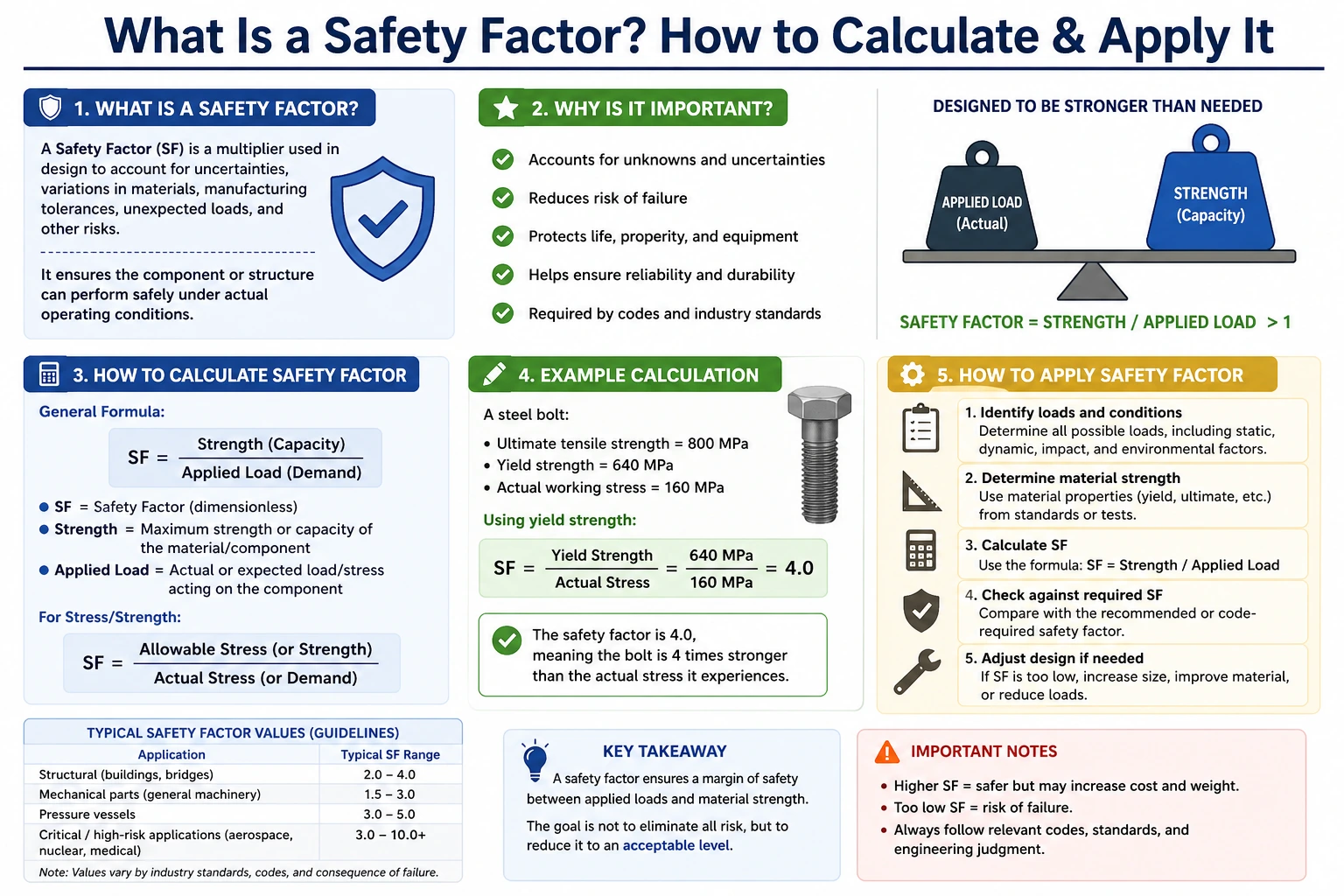
A safety factor (also called a factor of safety, or FOS) is the ratio between the maximum load a structure or component can handle versus the load it’s actually expected to handle.
Think of it like a bridge rated to hold 10 tons, but you only ever drive 2.5-ton trucks across it. That bridge has an FOS of 4 — it can handle four times more than it needs to.
This buffer exists because real-world conditions are unpredictable. Materials aren’t perfect, loads shift, temperatures change, and human error happens.
Why this matters for you: If you’re selecting equipment or reviewing a design spec, this ratio tells you exactly how much margin exists before something fails.
How It’s Expressed
The FOS appears in two common formats:
- Ratio format: 4:1 or simply “4” — meaning capacity is 4× the working load
- Percentage format: Less common, but you may see “400%” meaning the same thing
The higher the number, the more conservative (and typically safer) the design. A value of 1.0 means zero margin — the component is operating right at its limit.
Key takeaway: This is not a suggestion. It’s a calculated minimum that engineers set based on risk level and industry standards.
How to Calculate It
The Basic Formula
The math is straightforward:
FOS = Ultimate Load Capacity ÷ Working Load
- Ultimate Load Capacity — the maximum stress or force a material can withstand before failure
- Working Load — the actual force applied during normal use
Example: A steel cable can hold 50,000 lbs before breaking. You’re using it to lift loads of 10,000 lbs. FOS = 50,000 ÷ 10,000 = 5.
The challenge isn’t the formula — it’s knowing which numbers to plug in, and where to find them.
Where the Numbers Come From
| Value | What It Is | Where to Find It |
|---|---|---|
| Ultimate Load Capacity | Max strength before failure | Material datasheets, manufacturer specs |
| Yield Strength | Point where permanent deformation begins | Engineering tables, material certifications |
| Working Load Limit (WLL) | Max load for safe operation | Equipment labels, compliance documents |
| Design Load | Anticipated real-world load | Project specs, load calculations |
For most workplace applications, you won’t calculate from raw material data. You’ll compare the Working Load Limit (WLL) — already printed on certified equipment — against your actual load.
Why this matters for you: If a sling is rated WLL 2 tons and you’re lifting 1.8 tons, you’re within limit — but you need to know if that rating already accounts for a built-in ratio (it usually does, at 4:1 or 5:1 by industry standard).
Industry-Standard Ranges by Application
Different industries set different minimums based on risk level:
| Application | Typical FOS |
|---|---|
| Lifting equipment (cranes, hoists) | 4:1 to 5:1 |
| Steel structural members | 1.67:1 to 2:1 |
| Pressure vessels | 3:1 to 4:1 |
| Rope / rigging hardware | 5:1 to 10:1 |
| Scaffolding | 4:1 |
| Aerospace components | 1.2:1 to 1.5:1 |
Notice aerospace uses a lower ratio — not because safety matters less, but because weight is critical and materials are tested to extreme precision. Higher certainty in material performance = tighter acceptable margins.
Key takeaway: Always check which industry standard applies to your context before deciding if a given ratio is “good enough.”
How to Apply This in Real Decisions
Selecting Equipment
When choosing lifting gear, rigging, or structural components, don’t just check whether the rated load exceeds your need. Ask: what margin is built into that rating?
Certified lifting equipment in most countries (under ASME, EN, and ISO standards) has the ratio pre-applied. A sling labeled “WLL: 1 ton” is already rated with a 5:1 margin — meaning its actual break strength is around 5 tons.
If you’re buying non-certified or imported equipment, this may not hold. Always request test certificates.
Recognizing When Margins Are Being Reduced
Rated margins degrade in practice. Common causes:
- Wear and fatigue: A sling used 500 times has lower real capacity than a new one
- Temperature extremes: Heat weakens steel; cold makes some materials brittle
- Shock loading: A sudden jerk multiplies effective load — sometimes by 2× or more
- Angle loading: Rigging at an angle increases effective tension. A sling at 60° from vertical carries 15% more load than a vertical lift of the same weight
Why this matters for you: The rated margin assumes ideal conditions. Your job is to recognize when conditions aren’t ideal and compensate accordingly.
The Mistake of Treating the Margin as Optional Padding
A common misconception: “We’ve got a 4:1 ratio, so we can probably push to 80% of the break load if needed.”
No. The rated limit is the working ceiling — not a buffer to lean on. Operating beyond the WLL — even if you don’t reach the break point — is both a code violation and a serious risk. Equipment doesn’t fail at exactly its rated break point. It fails unpredictably, often below it, especially after wear.
Key takeaway: Treat the rated working limit as a hard ceiling, not a cushion.
Frequently Asked Questions
Q1: Is a higher FOS always better?
A: Not necessarily. A higher ratio means more conservative design — which adds weight, material cost, and sometimes reduces performance. Aerospace uses lower values intentionally because components are precision-tested and weight savings are critical. The right number balances risk level, material variability, and real-world conditions. “Higher is safer” is true up to a point, but over-engineering has its own costs.
Q2: What’s the difference between FOS and Working Load Limit (WLL)?
A: WLL is the maximum load you should ever apply to a piece of equipment in normal use — it’s a practical operational limit. FOS is the ratio between that limit and the actual breaking point. WLL already has the ratio baked in. When a manufacturer certifies a hook with a 2-ton WLL at 4:1, the hook’s break strength is 8 tons. You work with WLL day-to-day; the FOS explains the engineering logic behind it.
Q3: Does this concept apply outside physical engineering?
A: Yes. In IT infrastructure, systems are often designed with redundancy ratios (e.g., server capacity at 40% normal load to allow 2.5× surge). In financial modeling, stress tests apply similar logic. The term may not be used, but the principle — build in margin beyond expected demand — applies broadly across disciplines.
Q4: How do I know if used or rented equipment still meets its original rating?
A: Check for a current inspection certificate and load test date. Reputable rental companies re-certify equipment on a fixed schedule (typically annually for lifting gear). Look for visible wear: frayed rigging, deformed hooks, corrosion on load-bearing parts. If documentation is missing or unclear, treat the equipment as uncertified and escalate before use.
Q5: Can I calculate a custom ratio for a one-off project?
A: Yes, but only if you have reliable material strength data and a qualified engineer signs off. For most workplace scenarios, work within pre-certified equipment ratings and industry standards rather than deriving your own values. Custom calculations suit structural design or specialized fabrication — not improvised field decisions. When in doubt, use the most conservative standard that applies to your industry.
What you can do now: Next time you review a spec sheet or equipment label, locate the WLL and ask: what FOS standard does this follow? If it’s not stated, request the test certificate. That one habit will put you ahead of most people in your field.
To go deeper: Search for your industry’s specific standard — ASME B30 for cranes and rigging in North America, EN 13155 for lifting attachments in Europe, or ISO 4308 for crane selection globally. These are free to reference in summary form through your country’s standards body.