You’re reviewing a motor datasheet and the spec sheet lists “50 N·m of torque” — but nobody told you whether that’s strong, weak, or just right for the job. If that sounds familiar, you’re not alone.
The torque definition in mechanical engineering is one of the first concepts that trips up early-career engineers — and getting it wrong leads to real equipment failures. According to a 2023 survey by Machinery Lubrication, over 60% of new engineers admit they conflate torque with power during their first year on the job.
By the end of this article, you’ll know what torque is, how it’s calculated, how it differs from power, and how to use it when selecting or evaluating mechanical equipment. Read on.
Torque Definition in Mechanical Engineering
The one-sentence definition
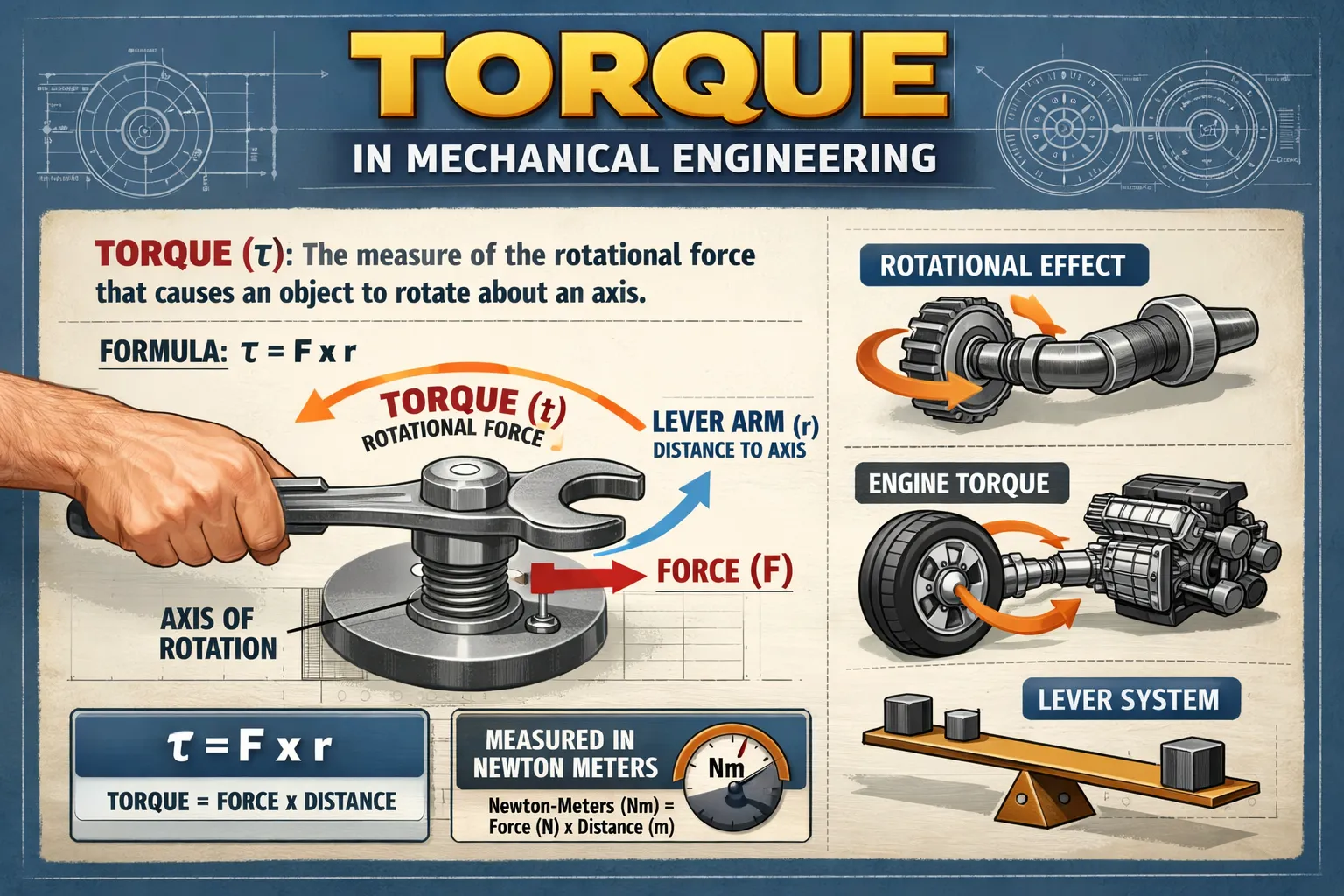
Torque (the rotational force that causes an object to spin around an axis) is a twisting push. Think of it like this: when you use a wrench to loosen a bolt, the force you apply at the end of the handle — combined with the length of that handle — is torque. A longer wrench handle produces more torque, even with the same arm strength.
The formula is straightforward:
Torque (τ) = Force (F) × Distance (r)
Distance here is measured from the center of rotation to where the force is applied. The standard unit is Newton-meters (N·m) in metric, or pound-feet (lb·ft) in imperial.
Why this matters for you: if a machine component isn’t turning when it should, the problem is almost always insufficient torque — not insufficient speed.
Torque vs. force: not the same thing
Force is a straight-line push or pull. Torque is a rotational push. A 100 N force applied 0.5 m from a shaft center produces 50 N·m of torque. That same 100 N force applied at 1 m produces 100 N·m.
This is why gear systems exist: they trade rotational speed for torque (or vice versa), without changing the underlying motor.
Section takeaway: Torque = twisting force × lever distance. Bigger lever or bigger force = more torque.
Torque vs. power: the confusion most engineers have
They are related — but not interchangeable
Power (the rate at which work is done, measured in watts or horsepower) and torque are connected by speed. Here’s the relationship:
Power (P) = Torque (τ) × Angular Velocity (ω)
A motor can have high torque but low power (like a slow, heavy-duty winch), or high power but low torque (like a high-speed grinding spindle). Neither is universally “better” — it depends entirely on what your application demands.
| Property | What it measures | Unit | Best suited for |
|---|---|---|---|
| Torque | Rotational force | N·m / lb·ft | Starting loads, clamping, tightening |
| Power | Rate of doing work | W / hp | Continuous operation, throughput |
| Speed (RPM) | Rotational rate | rev/min | Cutting, mixing, conveying |
When you need torque, and when you need power
Use torque as your primary selection criterion when:
- A machine must start under load (conveyors, compressors, elevators)
- You’re tightening fasteners or clamping workpieces
- The application involves high resistance at low speed
Use power as your primary criterion when:
- A machine runs continuously at steady speed
- You’re calculating energy consumption or operating cost
- You’re sizing cables, inverters, or electrical infrastructure
Why this matters for you: specifying a motor by power alone — without checking torque — is one of the most common causes of equipment that trips breakers on startup.
Section takeaway: Power tells you how fast a machine can work. Torque tells you how hard it can push. Always check both on a datasheet.
How torque works in real mechanical systems
Gears and torque multiplication
Gearboxes (mechanical assemblies that change rotational speed and torque between a motor and its load) are the most common way to modify torque in a system. A gear reduction of 5:1 means output speed drops to one-fifth — but output torque increases fivefold, minus friction losses.
This is why industrial conveyors and hoists use gearboxes even when the motor seems powerful. Raw motor torque is often too low and too fast for the load. The gearbox reshapes it.
Shafts, stress, and why torque limits matter
Every shaft has a maximum torque rating based on its material and diameter. Exceeding it causes torsional stress (the internal twisting stress inside a shaft) that leads to fatigue cracking or sudden fracture. Engineers calculate this using:
Shear Stress (τ_s) = T × r / J
Where T is torque, r is shaft radius, and J is the polar moment of inertia (a geometric property measuring resistance to twisting). You don’t need to solve this daily — but torque limits on components are hard limits, not suggestions.
Torque in fastener applications
Torque wrenches (tools that apply a preset, measurable twisting force to fasteners) exist because bolt clamping force is directly controlled by applied torque. Under-torquing means joints loosen under vibration. Over-torquing strips threads or causes bolt fatigue. Most maintenance manuals specify torque values in N·m for exactly this reason.
Section takeaway: Torque is multiplied by gearboxes, constrained by shaft geometry, and critical to fastener integrity. Each context has its own spec — always look it up.
Common mistakes when working with torque
Confusing static and dynamic torque
Static torque (the torque required to hold a load in place without movement) is often lower than starting torque (the torque required to accelerate a load from rest). Sizing a motor based only on running torque — while ignoring startup demand — causes stalls under load.
Rule of thumb: startup torque in many applications is 1.5–2.5× the running torque requirement. Check the motor’s torque-speed curve, not just its rated torque figure.
Ignoring efficiency losses in gearboxes
A gearbox rated to multiply torque by 10× doesn’t deliver 10× in practice — it delivers 10× minus friction losses. Typical gearbox efficiency is 92–98% per stage. Multi-stage gearboxes compound these losses. Always use the manufacturer’s efficiency figure, not the theoretical ratio, when calculating delivered torque.
Section takeaway: Never size a drivetrain on running torque alone. Account for startup conditions and gearbox losses.
Frequently Asked Questions
Q1: What’s the difference between torque and moment in engineering?
A: In most engineering contexts, the two terms mean the same thing — both describe a rotational force around a point. “Moment” is more common in structural and civil engineering (analyzing bending in beams). “Torque” is standard in mechanical and electrical engineering — motors, shafts, fasteners. The underlying formula is identical: force × distance. Don’t let the terminology variation trip you up on mixed-discipline projects.
Q2: How do I read a torque-speed curve on a motor datasheet?
A: A torque-speed curve plots available torque on the Y-axis against motor speed (RPM) on the X-axis. Most motors produce peak torque at low speed and taper off as speed rises. The key point to find: the rated operating point — the speed and torque at which the motor runs continuously without overheating. Never plan to run consistently beyond that point.
Q3: Is higher torque always better for a mechanical application?
A: No. Too much torque strips fasteners, overloads gearboxes, and damages workpieces. In precision applications — CNC spindles, medical devices, packaging lines — torque must stay within a tight range. More torque capacity gives you headroom, but the working torque should match the application spec, not be maximized for its own sake.
Q4: What units should I use — N·m or lb·ft?
A: Use whatever your project documentation or client standard requires, and stay consistent throughout. For international work or ISO-aligned specifications, N·m is the standard. For North American industrial and automotive applications, lb·ft remains common. The conversion: 1 lb·ft = 1.356 N·m. When in doubt, include both in your documentation to avoid ambiguity across teams.
Q5: Can I measure torque directly on a machine in the field?
A: Yes. Torque wrenches measure applied torque during fastener work. For rotating machinery, inline torque sensors (transducers inserted between a motor and its load) measure live torque during operation — useful for commissioning, efficiency testing, or diagnosing unexpected current draw. They’re not standard on every machine, but widely available as test instruments from most industrial suppliers.