You’ve just joined a manufacturing facility or warehouse operation. Someone mentions “the bridge crane in Bay 3 needs its hoist inspected.” Everyone nods. You nod too — but you’re not entirely sure what you just agreed with.
Bridge cranes are the backbone of heavy industrial material handling. They move everything from steel coils to aircraft engines to precast concrete panels. According to the Material Handling Industry association, overhead cranes handle an estimated 80% of all heavy lifting in U.S. manufacturing facilities.
By the end of this article, you’ll understand exactly what a bridge crane is, how its components work together, and which type fits which application — so you can participate in procurement discussions, safety briefings, and equipment audits with confidence.
Let’s break it down from the ground up.
What Is a Bridge Crane and How Does It Work?
The Core Concept
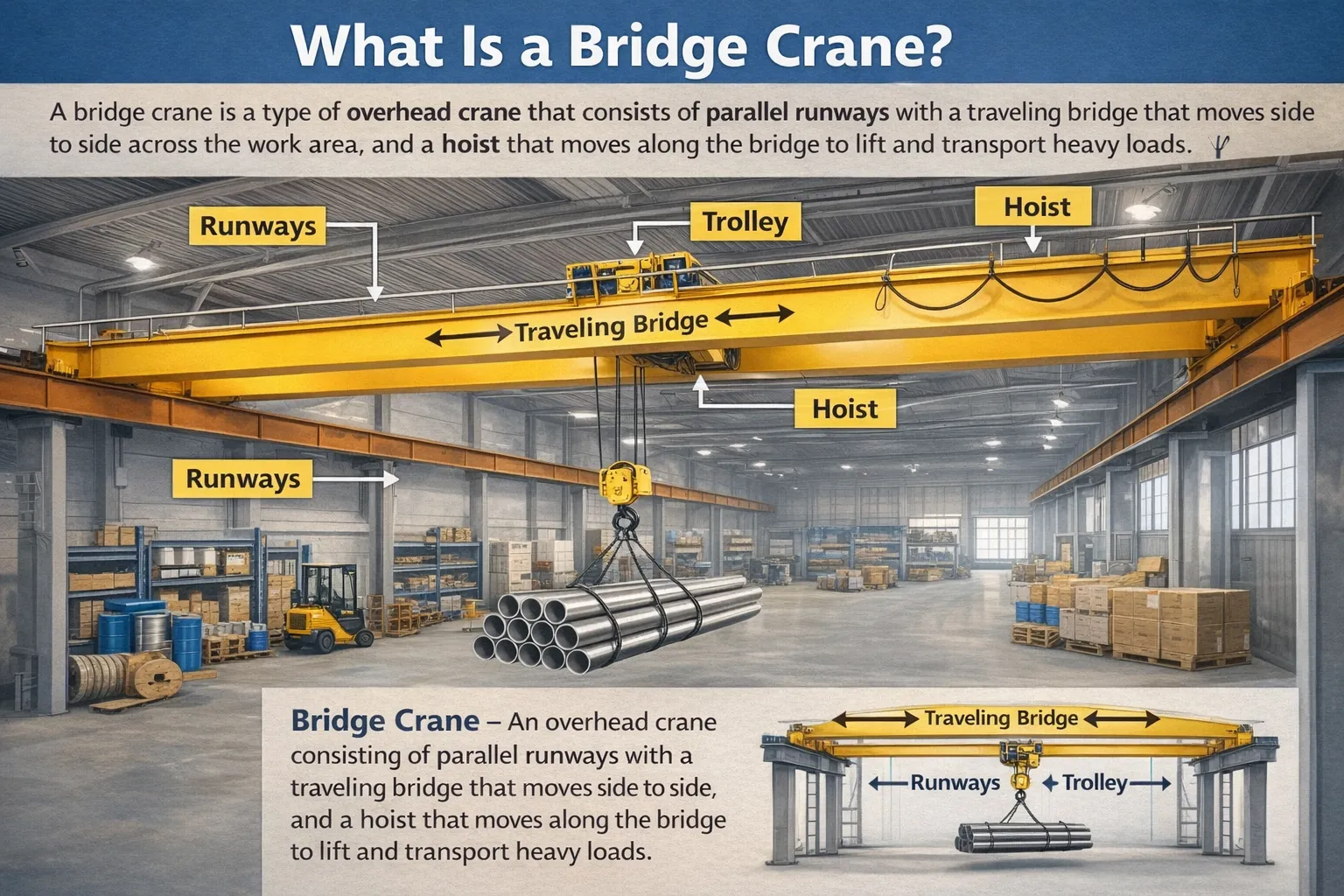
A bridge crane (also called an overhead crane — a lifting system that travels along elevated runway rails mounted to a building’s structure) gets its name from its most distinctive feature: a horizontal beam, called the bridge, that spans the width of a workspace like a bridge spans a river.
Here’s the simplest way to picture it: imagine a trolley running along a track. Now elevate that track to ceiling height and extend it the full length of a building. The trolley carries a hoist (a mechanical device that raises and lowers loads). That entire system — runway, bridge, trolley, hoist — is a bridge crane.
The result: a crane that can reach virtually any point within a rectangular work area, moving loads in three directions — left/right, forward/backward, and up/down.
Why this matters to you: Unlike forklifts, bridge cranes don’t occupy floor space and don’t require clear travel paths. They free up your entire floor for production.
The Key Components Explained
Every bridge crane shares the same fundamental anatomy:
- Runway rails: Parallel steel tracks mounted to columns or wall brackets. The crane travels along these end-to-end.
- End trucks: Wheeled assemblies at each end of the bridge beam that ride the runway rails.
- Bridge beam (girder): The horizontal spanning structure connecting both end trucks. This is the “bridge.”
- Trolley: A wheeled unit that travels laterally along the bridge beam.
- Hoist: The lifting mechanism — motor, drum, wire rope or chain, and hook — mounted to the trolley.
- Control system: Pendant (a handheld wired controller) or wireless remote that the operator uses.
Key takeaway: Every component has one job. When something fails, that component’s job stops — which is why knowing the anatomy helps you communicate problems accurately.
The Main Types of Bridge Cranes
Single-Girder vs. Double-Girder: The First Decision
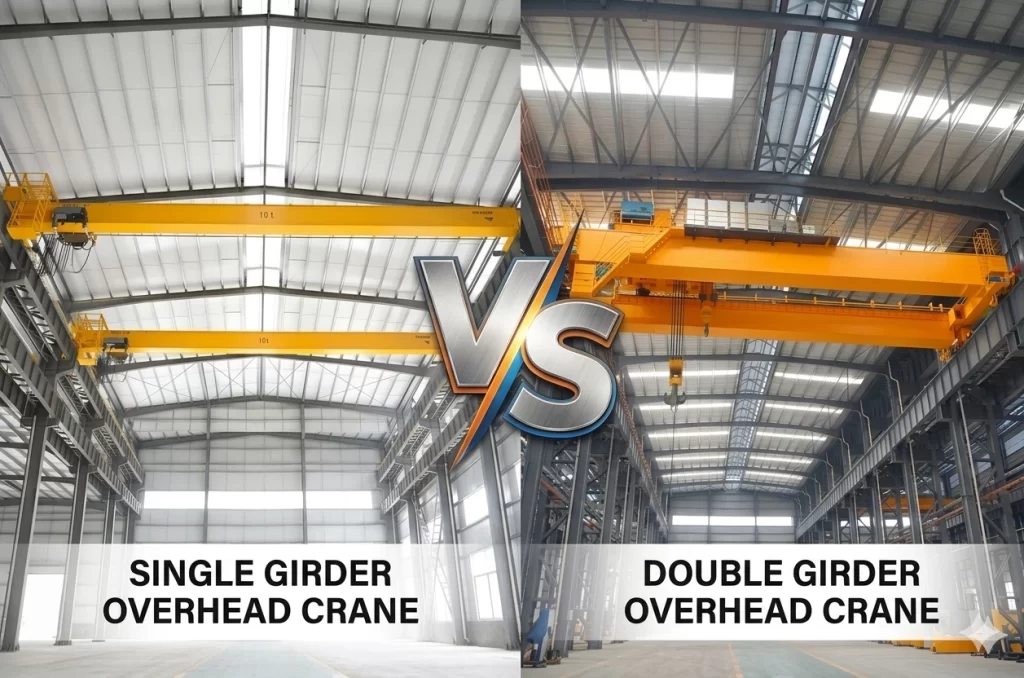
The most fundamental split in bridge crane design is how many bridge beams are used.
| Feature | Single-Girder | Double-Girder |
|---|---|---|
| Bridge structure | One beam | Two parallel beams |
| Typical capacity | Up to 10 tons | 10 tons and above |
| Hook height | Lower (hoist hangs below beam) | Higher (hoist sits on top rails) |
| Building headroom needed | Less | More |
| Self-weight | Lighter | Heavier |
| Best for | Light to medium duty, smaller spans | Heavy duty, wide spans, precision lifts |
Single-girder cranes are the workhorses of small-to-medium facilities — fabrication shops, warehouses, assembly lines. They’re simpler, lighter, and easier to install.
Double-girder cranes are built for demanding environments: steel mills, paper plants, shipyards, heavy machining centers. The two-beam design handles greater loads and wider spans without deflection (unwanted bending of the beam under load).
Top-Running vs. Underhung: The Mounting Difference
Beyond beam count, bridge cranes differ in how the end trucks connect to the runway:
Top-running cranes — the end trucks ride on top of the runway rails. This is the standard configuration for most industrial cranes. It supports higher capacities and longer spans.
Underhung cranes (also called underslung cranes) — the end trucks hang below the runway rail flange. The crane is suspended from the building’s structural steel rather than sitting on top of dedicated columns. This works well in facilities with limited ceiling height or where the crane needs to travel into adjacent areas through open doorways.
Why this matters to you: If you’re evaluating a crane for an existing building, the mounting type is often constrained by what the building structure can support — not just what the load requires.
Specialized Variants Worth Knowing
Once you move beyond standard configurations, you’ll encounter purpose-built designs:
- Gantry crane: A bridge crane that runs on ground-level rails instead of elevated runways — its legs support the bridge structure. Common in outdoor yards and shipbuilding docks.
- Semi-gantry crane: One end runs on an elevated runway, the other on a ground-level rail. Used when one wall can’t support a runway but floor space allows one ground leg.
- Jib crane: A smaller, single-arm crane mounted to a column or wall. Not technically a bridge crane, but often works alongside one to handle lighter precision tasks at individual workstations.
Key takeaway: Knowing the type name helps you read drawings, maintenance records, and procurement specs accurately — and ask the right questions when something needs replacing.
How to Evaluate a Bridge Crane for a Real Application
The Four Parameters That Matter First
When someone asks you to assess or specify a bridge crane, four numbers drive everything else:
| Parameter | Plain-Language Meaning | Typical Starting Question |
|---|---|---|
| Rated capacity (tons) | Maximum load the crane is designed to lift | What’s the heaviest single lift you’ll ever need? |
| Span (meters/feet) | Distance between runway rails | How wide is your bay? |
| Lift height (meters/feet) | Distance from floor to maximum hook position | How high does the load need to travel? |
| Duty class (A1–A8) | How intensively the crane will be used | How many lifts per shift, how many days per week? |
Duty class is the parameter beginners most often overlook. A crane rated for 5 tons in a light-duty class (occasional lifts, long rest periods) is engineered very differently from a 5-ton crane in a heavy-duty class (continuous cycling, multiple shifts). Using a light-duty crane in a heavy-duty role accelerates wear and creates safety risk — even if it never exceeds its rated capacity.
What “Rated Capacity” Doesn’t Tell You
Rated capacity is the load on the hook — but total crane load includes the weight of the hook block, slings, spreader bars, and any below-the-hook attachments.
A crane rated for 10 tons with a 500 kg hook assembly, two 200 kg slings, and a 300 kg spreader bar is carrying 1,000 kg of rigging before the actual load is attached. That leaves 9 tons of usable capacity — not 10.
Why this matters to you: Always calculate the total suspended weight, not just the payload. This is a routine check in any lift plan, and it’s your first line of safety verification.
Key takeaway: Capacity, span, lift height, and duty class are the four inputs that determine everything else — structure, motor size, rail size, and service intervals.
Frequently Asked Questions
Q1: What’s the difference between a bridge crane and an overhead crane?
A: They refer to the same equipment. “Overhead crane” describes where it’s mounted — above the workspace. “Bridge crane” describes its structure — a beam that bridges the runway rails. In practice, both terms appear in specs, safety standards, and supplier catalogs. Knowing both prevents confusion when reading documentation from different sources or regions.
Q2: How much floor space does a bridge crane require?
A: That’s exactly the point — bridge cranes require no floor space. The entire system is overhead. This makes them especially valuable in facilities where floor congestion from forklifts or carts creates safety or efficiency problems. The only floor footprint comes from the runway support columns, which are typically positioned at the building’s existing structural grid.
Q3: Can a bridge crane be installed in an existing building?
A: Yes, but the building structure must be evaluated first. The runway rails transfer significant dynamic loads into the building frame — especially during acceleration, braking, and side pull. A structural engineer must assess whether existing columns, beams, and foundations can handle these loads before installation. Retrofitting is common, but it sometimes requires reinforcing the building structure, which adds cost and planning time.
Q4: What maintenance does a bridge crane typically need?
A: Bridge cranes follow scheduled inspection intervals defined by standards like ASME B30.2 (U.S.) or FEM 1.001 (Europe). Routine checks cover wire rope condition, hook deformation, brake function, limit switches, and wheel wear. Lubrication of rails, wheels, and gearboxes is done at fixed intervals. Most facilities run a formal annual inspection by a qualified third party in addition to daily pre-shift operator checks.
Q5: What certifications or training do crane operators need?
A: Requirements vary by country and industry. In the U.S., OSHA 29 CFR 1910.179 sets the baseline for overhead crane operation in general industry. Many employers also require certification through NCCCO (National Commission for the Certification of Crane Operators). At minimum, operators must be trained on the specific crane type, load charts, hand signals, and emergency procedures before operating independently.