
You’re reviewing a supplier’s spec sheet for the first time. You see a row labeled “tensile strength: 400 MPa” — and you have no idea if that’s good, bad, or even relevant to your project.
This is a common situation. And it’s a costly one. Choosing a material without understanding its tensile strength can lead to structural failures, product recalls, or over-engineered designs that waste budget.
Here’s what you’ll know after reading this article: what tensile strength actually means, how to compare it across common materials, and what numbers matter for real-world decisions.
One data point to anchor this: structural steel failures cost the U.S. construction industry an estimated $1.5 billion annually — many traced back to misjudged material properties at the design stage.
Let’s start with the definition.
What Tensile Strength Actually Means
The Core Definition
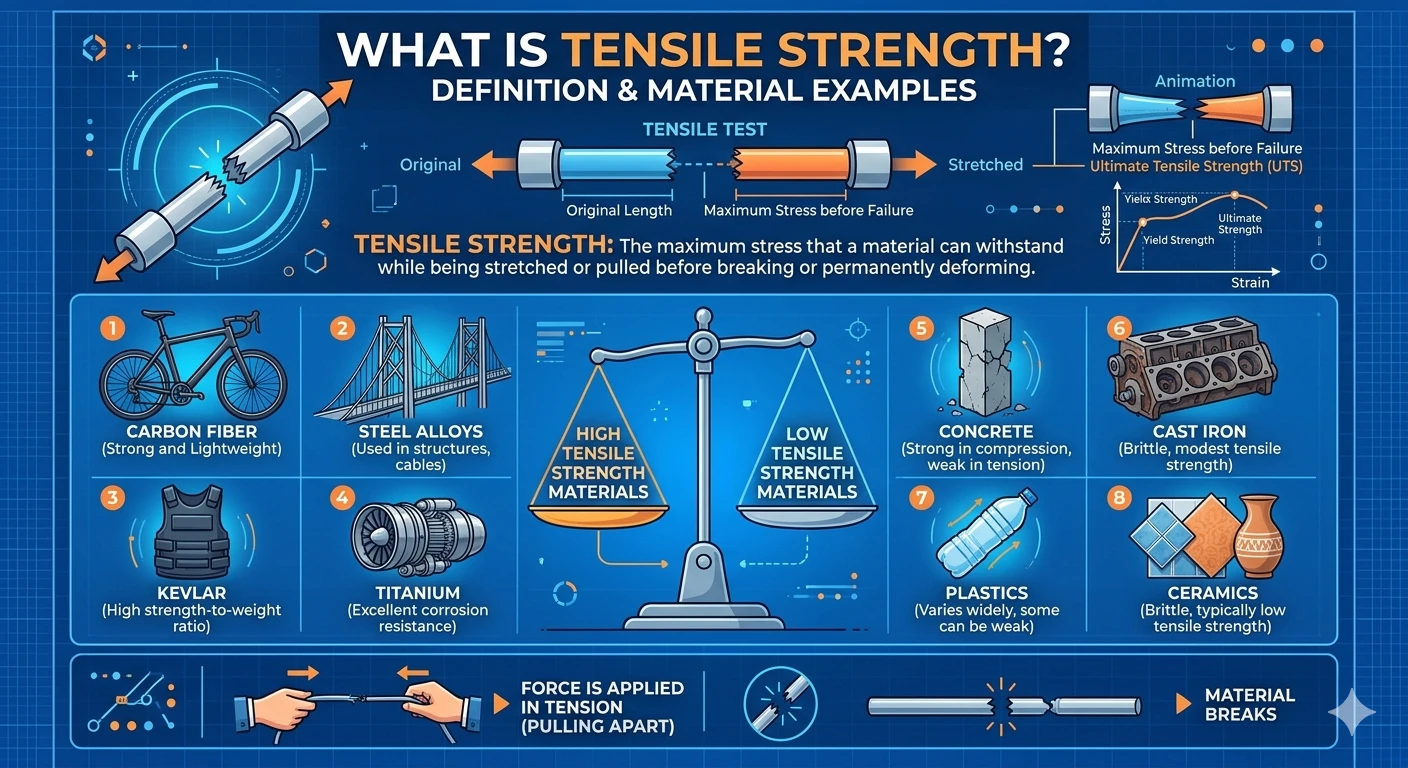
Tensile strength (the maximum stress a material can handle before it breaks under pulling force) is one of the most fundamental mechanical properties in engineering and manufacturing.
Think of it this way: imagine pulling a rubber band until it snaps. The moment just before it breaks — that’s the tensile limit in action. Now scale that concept to steel cables, plastic housings, or concrete beams.
The unit you’ll see most often is MPa (megapascals — a measure of force per unit area). Sometimes you’ll see psi (pounds per square inch) in American spec sheets. They measure the same thing.
Why this matters to you: If you’re involved in procurement, quality control, or product design, tensile strength is one of the first numbers you should check — before price, before lead time.
Ultimate vs. Yield Tensile Strength
There are two values you’ll encounter on spec sheets:
- Ultimate Tensile Strength (UTS): The maximum load a material can bear before it fractures.
- Yield Strength: The point at which the material starts to deform permanently — even if it hasn’t broken yet.
For most engineering applications, yield strength is the more conservative and safer reference point. A beam that bends and stays bent has already failed, even if it’s technically still “whole.”
Key takeaway: Always check both values. UTS tells you the breaking point; yield strength tells you the safe working limit.
How to Compare Tensile Strength Across Common Materials
The Numbers You Need to Know
Here’s a quick reference table for materials you’re likely to encounter in industrial, construction, or product manufacturing contexts:
| Material | Yield Strength (MPa) | Ultimate Tensile Strength (MPa) | Common Use Case |
|---|---|---|---|
| Structural Steel (A36) | 250 | 400–550 | Beams, frames, bridges |
| Stainless Steel (304) | 215 | 505 | Food equipment, piping |
| Aluminum Alloy (6061) | 276 | 310 | Aerospace, automotive parts |
| Titanium (Grade 5) | 880 | 950 | Medical implants, aircraft |
| Polycarbonate (PC) | 55–70 | 55–75 | Protective covers, lenses |
| Carbon Fiber Composite | 600–1000+ | 1500–3000+ | High-performance structures |
| Concrete (standard) | N/A | 2–5 (tension) | Compression applications |
Important note on concrete: Concrete is strong under compression but extremely weak under tension. That’s exactly why it’s reinforced with steel rebar — the steel handles the tensile load.
Reading a Spec Sheet Without Getting Lost
When you open a material data sheet, look for these fields:
- Rm or UTS = Ultimate tensile strength
- Rp0.2 or Yield = 0.2% offset yield strength (the standard engineering yield reference)
- Elongation at break (%) = how much the material stretches before snapping — higher means more ductile (able to deform without cracking)
A material with high UTS but low elongation is strong but brittle — like glass. High elongation with moderate UTS means it’s tough and forgiving — like mild steel.
Key takeaway: Don’t just look at the big number. The ratio between yield and ultimate strength, plus elongation, tells you far more than UTS alone.
Common Mistakes When Using Tensile Strength Data
Mistake 1: Confusing Tensile Strength with Hardness
These are not the same property. Hardness (resistance to surface scratching or indentation) and tensile strength (resistance to being pulled apart) can correlate loosely for metals — but not always.
Cast iron is very hard but has low tensile strength. It resists scratching but shatters under tension. Copper is relatively soft but has decent tensile strength and high ductility.
Using hardness data as a proxy for tensile performance is a beginner mistake that can lead to serious design errors.
Mistake 2: Ignoring Temperature and Environment
Tensile strength values on spec sheets are measured at room temperature (typically 23°C / 73°F) under controlled lab conditions.
In real applications — an outdoor steel structure in winter, a plastic component near a heat source — performance can change significantly. Metals generally lose strength at high temperatures. Some polymers become brittle in cold environments.
If your application involves temperature extremes, ask your supplier for elevated-temperature tensile data or check standards like ASTM E21 for metals.
Mistake 3: Applying Single-Axis Data to Multi-Directional Loads
Standard tensile tests pull a material in one direction. Real-world loads often come from multiple angles simultaneously.
Composite materials like carbon fiber are particularly tricky here — they can be extremely strong along the fiber direction but weak perpendicular to it. Always confirm the loading direction matches the tested orientation.
Key takeaway: Tensile strength data is a starting point, not the full picture. Context — temperature, load direction, surface conditions — determines real performance.
Frequently Asked Questions
Q1: What’s the difference between tensile strength and compressive strength?
A: Tensile strength measures how well a material resists being pulled apart. Compressive strength measures resistance to being crushed or squeezed. Many materials behave very differently under each type of load. Concrete, for example, is excellent under compression (handles heavy loads pressing down) but weak under tension. That’s why concrete structures almost always include steel reinforcement to handle tensile forces.
Q2: Is higher tensile strength always better?
A: Not necessarily. Very high tensile strength often comes with reduced ductility — meaning the material becomes more brittle and may crack suddenly without warning instead of bending first. In applications where energy absorption or impact resistance matters (like car body panels), a lower-strength but more ductile material may actually be the safer and better choice.
Q3: How is tensile strength tested?
A: A standardized test sample (called a “dogbone” specimen due to its shape) is clamped into a machine that pulls both ends apart at a controlled rate. The machine records the force applied versus the elongation until fracture. This test follows standards like ASTM E8 (metals) or ISO 527 (plastics). Third-party labs perform these tests, and results are reported on material certificates.
Q4: Can I improve the tensile strength of a material after manufacturing?
A: Yes, for metals. Heat treatment processes — like quenching and tempering for steel, or age hardening for aluminum alloys — can significantly increase tensile and yield strength. However, these processes often reduce ductility. For polymers, adding fiber reinforcement (glass or carbon fiber) is the most common way to boost tensile performance after the base material is chosen.
Q5: What tensile strength should I look for when selecting bolts or fasteners?
A: Bolt grades are directly tied to tensile strength. For metric bolts, the grade marking tells you the story: a Grade 8.8 bolt has a UTS of 800 MPa and a yield strength of 640 MPa (the second digit represents 80% of UTS). For high-load or safety-critical joints, Grade 10.9 or 12.9 bolts are common. Always match the bolt grade to your calculated joint load — don’t upgrade “just to be safe” without rechecking the entire joint design.