You sit in a supplier review meeting. The team discusses a complex housing part, and the quote highlights metal casting as the production method. Everyone nods, but you wonder: is this the right choice for tolerances, cost, or lead time? Many professionals face this exact moment early in their careers.
Read this guide and you will learn a clear definition of metal casting, its core types, the full process from pattern to finished part, and how to apply it in real projects. Industry data shows 90 percent of all manufactured goods contain some metal castings. This fact alone explains why the method powers everything from car engines to medical implants.
You will walk away ready to ask smarter questions and spot better options next time a drawing lands on your desk. Let’s dive in.
What Metal Casting Is and Why It Matters
Simple Definition You Can Explain in 30 Seconds
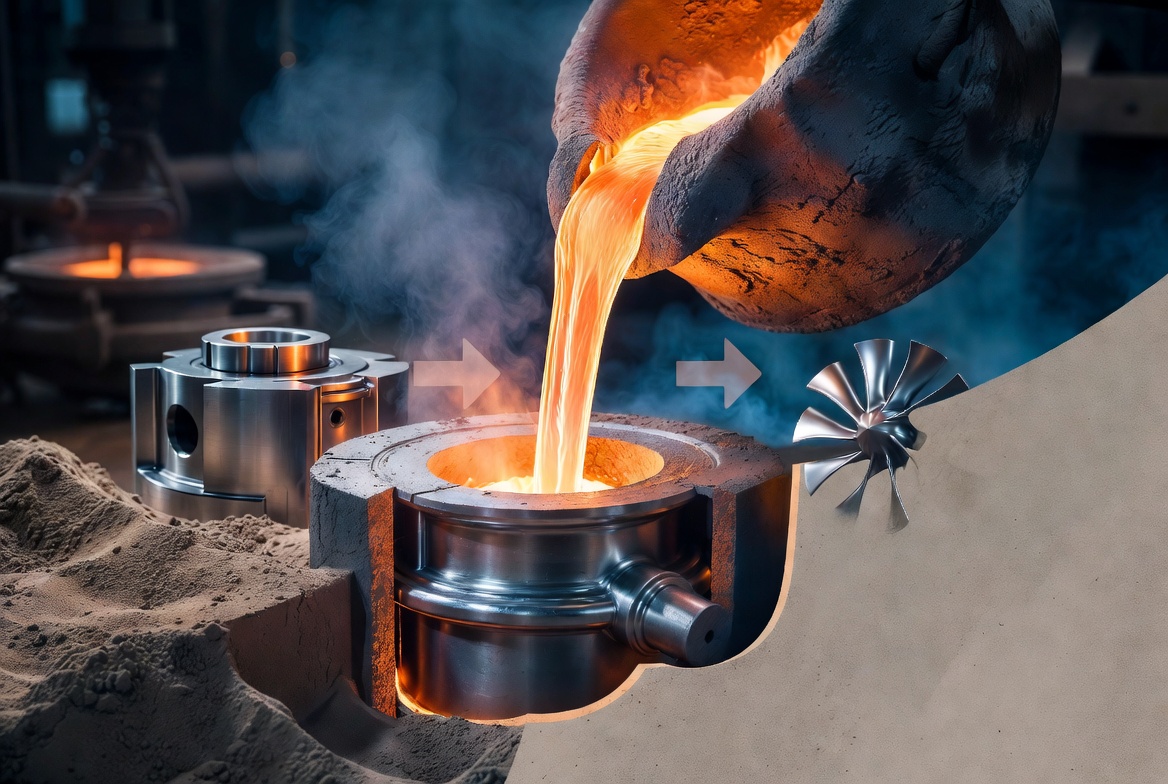
Metal casting pours molten metal into a mold cavity. The metal cools and solidifies into the exact shape you need. Picture pouring hot chocolate into an ice tray. The tray is the mold. The chocolate is the metal. Once it hardens, you pop out the finished shape.
This process creates parts with internal channels or complex curves that machining cannot achieve easily.
Why this matters to you: You can now join design reviews and suggest casting when the part geometry looks intricate or the volume justifies the tooling.
Key Advantages That Save Time and Money
Casting handles large parts or detailed features without wasting material. Engineers design one mold and reuse it across hundreds or thousands of pieces. The method also works with many alloys, from lightweight aluminum to strong steel.
Why this matters to you: In tight project budgets, you identify casting as a lower-cost route than forging or 3D printing for mid-volume runs.
One Early Pitfall That Trips Up Beginners
Newcomers often assume every casting method delivers the same surface finish or accuracy. In reality, each approach trades off speed, cost, and precision.
Why this matters to you: You avoid approving a supplier quote that looks cheap but delivers rough parts requiring extra machining.
Takeaway: Grasp what metal casting delivers so you can match the method to your project’s exact needs and timelines.
The Step-by-Step Process Explained Simply
Pattern and Mold Creation Comes First
Start with a pattern that matches the final part shape, usually made from wood, plastic, or metal. Workers pack sand or another material around the pattern to form the mold. They remove the pattern, leaving a hollow space.
Why this matters to you: You now understand why lead times include tooling design—changes here affect every piece produced.
Melting and Pouring Requires Careful Control
Foundry teams heat metal in a furnace until it flows like water. They pour the liquid metal into the mold at a controlled speed to avoid air bubbles or cold spots.
Why this matters to you: You can ask suppliers about their pouring temperature records when quality issues arise later.
Cooling, Removal, and Finishing Completes the Part
The metal cools and shrinks slightly inside the mold. Workers break away the mold, cut off extra material called gates and risers, then clean and machine the surface if needed.
Why this matters to you: You recognize why some cast parts arrive with visible seams or need secondary operations.
Takeaway: Follow the full process mentally and you will predict delays or quality risks before they hit your production schedule.
Main Types of Processes and How to Select the Right One
Sand Casting: Flexible Choice for Larger Parts
Sand casting presses a pattern into specially prepared sand to form a temporary mold. After pouring and cooling, the sand breaks away. This method suits low to medium volumes and parts weighing from a few pounds up to several tons.
Why this matters to you: You recommend sand casting when your team needs a quick prototype or a one-off large housing without expensive permanent tooling.
Die Casting: High-Volume Precision for Smaller Components
Die casting forces molten metal under pressure into a reusable steel mold called a die. The process repeats quickly, delivering consistent parts with smooth surfaces. It works best with lower-melting alloys such as aluminum or zinc.
Why this matters to you: For consumer electronics or automotive brackets, you calculate that die casting lowers per-piece cost once volume exceeds a few thousand units.
Investment Casting: Precision for Intricate Designs
Investment casting builds a wax pattern, coats it with ceramic slurry, and melts the wax away. Molten metal fills the ceramic shell. The method achieves tight tolerances and fine details on complex shapes.
Why this matters to you: You choose investment casting for turbine blades or medical instruments where thin walls and smooth finishes matter most.
| Type | Mold Type | Best Production Volume | Typical Part Size | Surface Finish Quality | Dimensional Tolerance |
|---|---|---|---|---|---|
| Sand Casting | Disposable sand | Low to medium | Medium to very large | Rough | ±0.5–2 mm |
| Die Casting | Reusable steel | High | Small to medium | Smooth | ±0.05–0.2 mm |
| Investment Casting | Ceramic shell | Low to medium | Small to medium | Very smooth | ±0.05–0.1 mm |
Technical Parameters Made Easy
Shrinkage Allowance
Popular explanation: Extra space built into the mold to compensate for metal shrinking as it cools.
Standard value: 1–2 % depending on alloy.
Pouring Temperature
Popular explanation: Heat level that keeps metal fully liquid during filling.
Standard value: Aluminum alloys around 700 °C; cast iron around 1,400 °C.
Takeaway: Match the type to your volume, size, and finish requirements so your next supplier conversation focuses on results instead of guesswork.
Real-World Applications That Shape Everyday Products
Automotive and Heavy Equipment Rely on Cast Parts
Engine blocks, transmission cases, and pump housings often start as castings. The process creates internal cooling passages in one step that would otherwise need multiple welded pieces.
Why this matters to you: You evaluate supplier proposals faster when you know why casting keeps vehicle weight and assembly steps low.
Aerospace and Medical Devices Demand Precision
Turbine blades and orthopedic implants use investment casting for thin, strong walls. The method meets strict weight and strength rules without extra machining.
Why this matters to you: In regulated industries you ask the right questions about material certification and process controls.
How to Assess Suitability for Your Next Part
Review the drawing for uniform wall thickness and rounded corners. Add draft angles so the part releases from the mold. Check production volume against tooling costs.
Why this matters to you: You catch design changes early and prevent expensive rework after the first samples arrive.
Takeaway: Apply these application examples and you will recommend casting confidently when it solves your team’s geometry, strength, or cost challenges.
After reading this you should now be able to explain metal casting basics in any meeting, compare supplier options by type, and flag design issues before prototypes. You understand why 90 percent of manufactured goods depend on this process and how to choose the right method for your specific part.
Take immediate action: Pull up your current project drawing and check for draft angles and uniform walls. Mark one area that might benefit from casting redesign. Share your notes with the engineering lead today.
For deeper insight, study resources from the American Foundry Society on part design guidelines. They offer free technical papers that translate directly to better decisions on the job.
If you would like to learn more about this topic, you can consult the American Foundry Society Casting Design Guide and the Steel Founders’ Society of America Technical Manual.
Frequently Asked Questions
Q1: How does metal casting differ from forging?
Casting pours liquid metal into a mold, while forging hammers or presses solid metal into shape. Casting excels at complex internal features and large sizes. Forging produces stronger grain structure but limits design freedom. Use casting for intricate housings and forging for high-stress shafts. This distinction helps you select the process that matches both geometry and mechanical demands without over-specifying.
Q2: What are the most common defects in cast parts and how can teams prevent them?
Porosity appears as tiny holes from trapped gas. Shrinkage voids form when metal cools unevenly. Cold shuts happen when metal streams meet but do not fuse. Prevent them with proper gating design, controlled pouring temperature, and good mold venting. Ask suppliers for X-ray or ultrasonic inspection reports on critical parts. Early detection during sampling saves costly field failures later.
Q3: Which metals work best with different casting methods?
Aluminum alloys suit die and sand casting because they melt at lower temperatures and flow well. Cast iron performs reliably in sand casting for large, durable components. Stainless steel and superalloys favor investment casting for precision and heat resistance. Match the alloy to the process so you avoid cracking or poor fill issues. Review material datasheets together with your design team before finalizing the method.
Q4: Is metal casting suitable for prototype development or only high-volume production?
Sand casting and investment casting work well for prototypes because they require minimal upfront tooling. You can produce one or ten pieces quickly to test fit and function. Die casting becomes economical only after volumes justify the steel dies. Start with a sand-cast prototype to validate your design, then switch methods once demand scales. This staged approach keeps early costs low and risk controlled.
Q5: How has 3D printing changed the way teams approach metal casting?
3D-printed patterns and molds shorten tooling lead times from weeks to days. Designers create complex internal cores that traditional patterns cannot achieve. Hybrid workflows let you print a sand mold directly for low-volume runs. The technology also supports rapid iteration during prototyping. Explore foundries that offer printed tooling so you accelerate development cycles without sacrificing casting quality.