
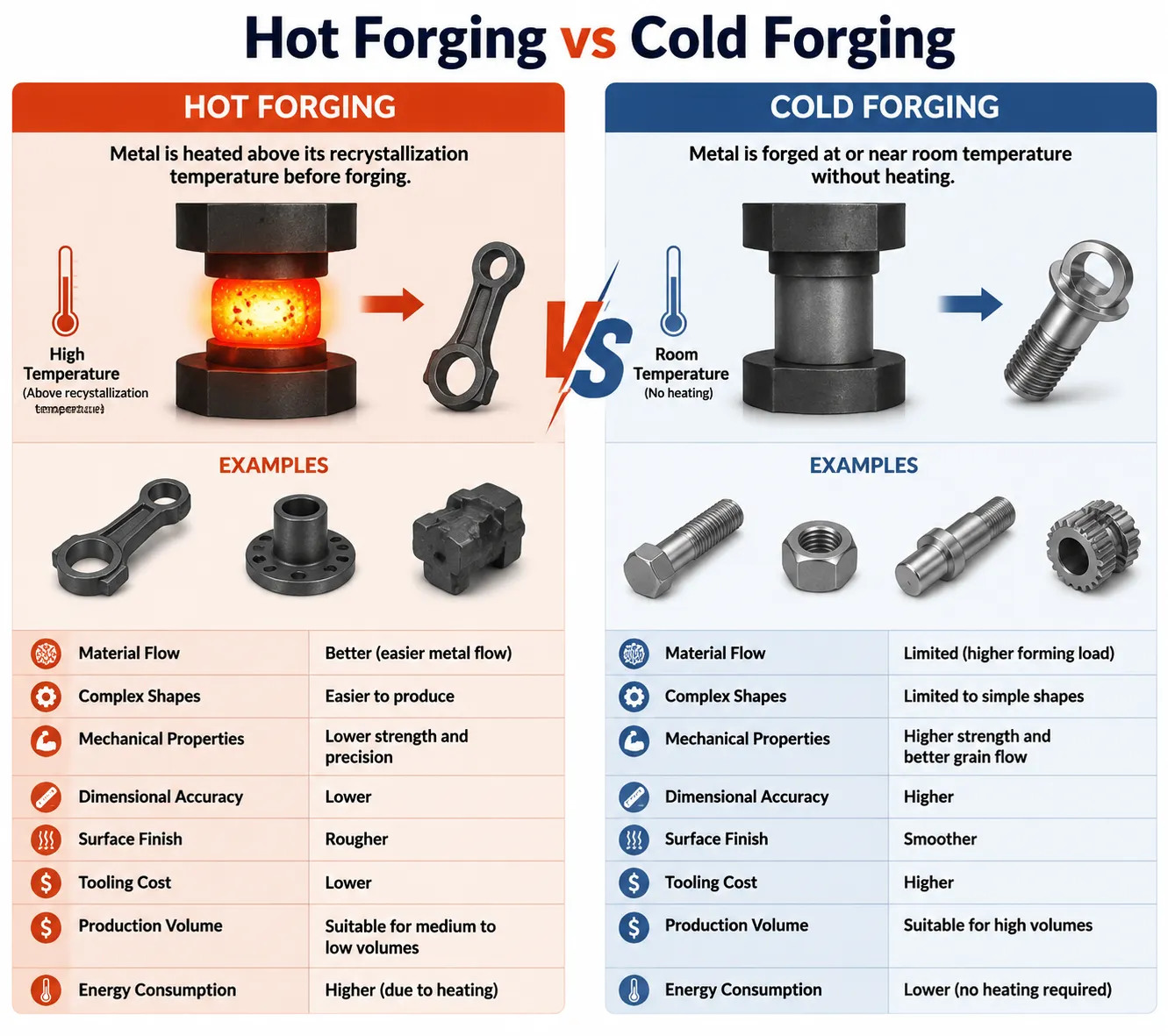
Hot Forging vs Cold Forging – $200–$15,000 market reference. Compare processes, specs, certifications .
Quick Reference
| Item | Hot Forging | Cold Forging |
|---|---|---|
| Typical Cost ($) | $200–$12,000 | $400–$15,000 |
| Suitable Materials | Carbon steel, alloy steel, aluminum | Low‑carbon steel, alloy steel, copper alloys |
| Compression Ratio | 3:1 – 8:1 | 2:1 – 5:1 |
| Precision | ±0.5 mm (post‑machining) | ±0.2 mm (near‑net) |
| Surface Finish | Rough‑cast, requires machining | Near‑net, minimal machining |
| Typical Applications | Wheels, shafts, connecting rods, structural parts | Precision gears, bolts, aerospace fasteners |
| Key Certifications | CE, ISO 9001, ISO 14001 | CE, ISO 9001, ISO 14001 |
| Lead Time | 2–4 weeks | 1–3 weeks |
Conclusion: For large‑batch, thick‑wall, cost‑sensitive parts, choose Hot Forging. For high‑precision, low‑post‑processing needs, Cold Forging offers better value.
Hot Forging Overview
Atomic assertion: Hot forging performed above 1100 °C plastically deforms metal, significantly improving density and mechanical properties.
Hot forging reshapes metal at re‑crystallization temperatures using open‑die hammers, closed‑die presses, or isothermal presses. Benefits include higher strength, lower unit cost for large batches, and ability to form large, complex shapes.
Key Technical Parameters
- Maximum forging temperature: 1100 °C–1250 °C (ASTM A108)
- Compression ratio: 3:1–8:1 (ISO 9001)
- Forging speed: 0.1–10 m/s (EN 12296)
- Post‑treatment: normalizing, quenching, tempering (ISO 9001)
Typical Applications
- Automotive: connecting rods, crankshafts, steering arms
- Railway: wheels, axles, bridge nodes
- Energy: compressor impellers, boiler supports
Cold Forging Overview
Atomic assertion: Cold forging at room temperature or below 400 °C yields high‑strength parts with ultra‑fine dimensional accuracy.
Cold forging forms metal without pre‑heating. High‑pressure machines such as stamping presses, hydraulic presses, and equal‑channel angular presses are used. Advantages include near‑net shape, excellent surface finish, and material savings.
Key Technical Parameters
- Maximum forging temperature: ≤ 400 °C (ISO 14324)
- Compression ratio: 2:1–5:1 (ISO 9001)
- Forming force: 200 kN–2 MN (EN 13445)
- Post‑treatment: low‑temperature aging or direct use (ISO 14001)
Typical Applications
- Precision gears, bolts, aerospace fasteners
- Electronics: heat sinks, conductive terminals
- Medical: surgical implants, tools
Selection Decision Framework
| Requirement | Hot Forging Advantage | Cold Forging Advantage |
|---|---|---|
| Material thickness | >30 mm (thick walls) | ≤30 mm (thin walls) |
| Batch size | Large (≥1000 pcs) | Medium/Small (≤500 pcs) |
| Precision | ±0.5 mm (post‑machining) | ±0.2 mm (no post‑machining) |
| Cost sensitivity | Low unit cost, higher post‑processing | Higher unit cost, lower post‑processing |
| Lead time | 2–4 weeks (tooling) | 1–3 weeks (simpler tooling) |
| Certification | CE, ISO 9001, ISO 14001 | Same certifications |
Selection advice: Assess material thickness and batch volume first, then weigh precision and cost to choose the optimal forging method.
Purchasing & Certification Guidelines
CE & ISO Certification
CE marking complies with EU Directive 2014/68/EU for pressure equipment. ISO 9001:2015 ensures a robust quality management system. beikaowan’s forged products carry CE numbers and ISO certificates, downloadable at /certificates/iso.
Pricing Structure (Market Reference)
- Small fasteners (M6 bolt): $0.20–$0.50 (hot), $0.35–$0.80 (cold)
- Medium gears (D50): $15–$45 (hot), $30–$85 (cold)
- Large connecting rods (L200): $200–$800 (hot only)
- Ultra‑thin sheets (≤2 mm): cold only $400–$1,200
Discounts: ≥5% off for orders ≥10 pcs, ≥10% off for ≥50 pcs.
Purchasing Process
- Define material, dimensions, tolerance, and delivery date.
- Submit technical specification PDF via beikaowan’s online form to receive a detailed process recommendation.
- Click “Get a free quote” below, fill in company details and quantity.
- Request a sample (up to 5 pcs, buyer pays shipping) before committing to large orders.
- Sign the PDF contract (includes lead time, payment terms, quality guarantees).
Common Misconceptions & Best Practices
Hot forging is always cheaper
Atomic assertion: Hot forging’s unit cost is low for mass production, but post‑machining and heat‑treatment can raise total cost for small batches.
Cold forging can be used for thick sections
Atomic assertion: Cold forging of thick sections often leads to cracking and internal defects.
Ignoring certifications
Atomic assertion: Lack of CE or ISO certification disqualifies parts in EU‑regulated projects.
Conclusion
Hot Forging vs Cold Forging: Hot forging excels for high‑volume, thick‑wall components; cold forging delivers superior precision and low post‑processing for thin‑wall, high‑precision parts. Choose based on material thickness, batch size, precision needs, and overall cost.